
The Rise of Myopia in India: Why are Eyes Failing at a Younger Age?
In India today, the sight of a five-year-old wearing thick spectacles is becoming alarmingly common. Walk into any IT park in Bengaluru or Hyderabad, and you will see thousands of young professionals rubbing their eyes by 4 PM, battling digital fatigue.
We have accepted that deteriorating vision is an inevitable part of modern life or ageing. But is it really helpless?
At Move & Shine, we believe that while genetics play a role, your lifestyle is a massive contributing factor to how fast your vision deteriorates. The current “myopia boom” in India isn’t just about genes; it’s about our environment.
The good news is that new research shows we can intervene. While we may not be able to fully reverse an existing refractive error, we can significantly slow down its progression, reduce digital strain, and delay the dependency on corrective lenses. Here is your evidence-informed guide to maintaining natural vision in a digital world.
1. The Indian Reality Check: Why Are Our Eyes Failing Faster?
Twenty years ago, the average Indian child spent evenings playing cricket or badminton outside. Today, due to academic pressure (the tuition culture), shrinking open spaces in cities, and the allure of smartphones, their world has shrunk to a 6-inch screen held 30 centimeters from their face.
This creates two major problems:
Lack of Distance Vision: Our eyes are designed as “hunters”—meant to scan horizons. When we constantly look at near objects (books, screens), the eye muscles lock into a state of chronic tension (accommodative spasm).
Digital Blue Light & Flicker: Indian homes often have harsh tube lighting or dim corners. Combining this with flickering screens causes immense metabolic stress on the retina.
The result? A massive spike in Myopia (nearsightedness) in kids and severe Computer Vision Syndrome (CVS) in adults.
2. The Protective Habit: The Power of Outdoor Sunlight
If there is one magic bullet for delaying glasses in children, this is it. Multiple global studies have confirmed that children who spend more time outdoors have a significantly lower risk of developing myopia.
It’s not just about looking at faraway things. The sun’s brightness triggers the release of dopamine in the retina. Dopamine acts as a “stop signal,” preventing the eyeball from elongating too quickly (which is the physical cause of myopia).

Dr. Donna Susan’s Insight: “Many worried parents ask me which expensive vitamins to buy for their child’s eyes. I tell them the best vitamin is free: ‘Vitamin D’ from sunlight. The indoor lifestyle of urban India is the primary driver of the myopia epidemic. Aim for at least 90 minutes of outdoor time daily before 5 PM.”
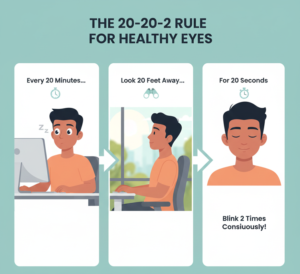
3. Screen Hygiene: How to Use the 20-20-20-2 Rule
In a country where “Screen Time” is often synonymous with “Study Time” or “Work Time,” we cannot simply ask people to stop using devices. Instead, we must teach Screen Hygiene.
The gold standard for eye relaxation is the 20-20-20 Rule:
Every 20 minutes…
Look at something 20 feet away…
For at least 20 seconds.
At Move & Shine, we add a fourth ‘2’: Blink 2 times consciously. When we stare at screens, our blink rate drops from 15 times a minute to just 5. This causes the tear film to evaporate, leading to dry eyes and blurry vision.
4. Visual Ergonomics: Why Your Posture Affects Your Sight
In many Indian households, children study sprawled on the bed or hunched over a low “teapoy” (coffee table). This is a recipe for visual disaster.
When you are too close to your book or screen (less than 30cm), your eye muscles have to work overtime to “accommodate” or focus. Over time, this constant strain causes the eyeball to elongate.
“Vision isn’t just about the eyes; it’s about the whole body. If you are slouching, your neck muscles tighten, which restricts blood flow to the head and increases ocular fatigue. We often see that improving a child’s study chair and desk height significantly reduces their complaint of evening headaches.”
The “Harmon Distance”
The ideal reading distance is the length from your knuckle to your elbow. Anything closer than that is putting your “Eye Focus System” in the red zone.
5. The “Indian Eye Diet”: Best Foods for Eye Health
While “eating carrots” is a popular myth, the science of ocular nutrition is much broader. The Indian kitchen is actually a goldmine for eye health.
Lutein and Zeaxanthin: Found in Spinach (Palak), Drumstick leaves (Moringa), and Yellow Corn.
Vitamin C: Amla (Indian Gooseberry) is the most potent source, protecting against oxidative stress.
Omega-3 Fatty Acids: Critical for the oil layer of tears. Found in Walnuts and Flaxseeds.
Vitamin A: Found in Papaya, Mangoes, and Sweet Potatoes.

6. Structured Eye Exercises (Vision Therapy)
Many people think eye exercises are “yoga” for the eyes. In clinical terms, we call this Vision Therapy.
The “Thumb Push-Up” (Accommodation Drill)
Hold your thumb at arm’s length. Focus on the nail.
Slowly bring the thumb toward your nose while keeping it in clear focus.
Once it blurs, move it back out.
Repeat 10 times.
This exercise strengthens the ciliary muscles, potentially delaying the need for reading glasses (Presbyopia) as you hit your 40s.
7. Optimal Lighting for Study and Work
Many Indian students study under a single, dim LED bulb.
Ambient Light: Your room should be as bright as your screen. Never use a laptop in a dark room.
Positioning: Light should come from the side or behind, never reflecting directly off the screen into your eyes.
8. The “Digital Fast” Before Bed
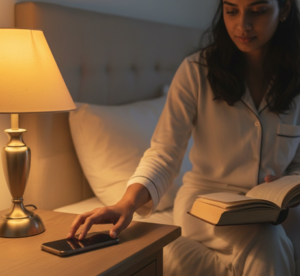
The blue light from smartphones suppresses Melatonin, the sleep hormone. Poor sleep quality leads to “Eye Fatigue” the next morning.
The Rule: No screens 60 minutes before bed.
The Benefit: Allows metabolic waste in the retina to clear out overnight.
9. When to See an Eye Specialist (Preventive Care)
The goal of these habits isn’t to avoid doctors; it’s to make your visits “preventive” rather than “emergency.”
Dr. Donna Susan’s Insight: “Most people wait until they can’t read the newspaper to visit me. By then, the eye has already undergone structural changes. Early visits allow us to use ‘Myopia Control’ strategies that can stop the power from increasing further.”
Frequently Asked Questions (FAQs)
1. Can eye exercises actually remove my existing glasses?
No. If you have a refractive error, your eyeball has physically changed shape. Exercises won’t change the shape back, but they can stop the power from increasing.
2. Is it true that “Palak” (Spinach) can improve vision?
Yes, but indirectly. It contains Lutein, which protects your Macula against age-related damage.
3. Does splashing water on my eyes help?
Actually, excessive splashing can wash away healthy oils, leading to dry eyes. A warm compress is better for tired eyes.
4. My child has 6 hours of online classes. Is damage inevitable?
Not if you follow the “Outdoor Rule.” For every hour of near-work, give the child 20 minutes of outdoor play or distance looking.
5. Do Blue-Light blocking glasses really work?
They reduce glare, but they are not a substitute for the 20-20-20 rule. Taking breaks is 10x more effective.
6. Can I delay “Reading Glasses” (Presbyopia)?
Everyone will eventually need them, but good habits can delay the need from age 42 to age 48.
7. Why is my vision blurry only in the evenings?
This is often “Pseudo-myopia”—a temporary blur caused by eye muscles being locked in a ‘near’ position.
8. Are mobile dark modes better for the eyes?
In low light, yes. For long reading, black text on a light background is often easier for the brain.
9. Does “Ghee” help eye health?
Ghee provides Vitamin A and healthy fats. It’s good for tear quality as part of a balanced diet.
10. How often should I get an eye checkup?
Once a year for children; once every two years for adults under 40; annually for those over 40.
Conclusion: Your Vision is a Habit, Not a Destiny
While we live in a world designed to strain our eyes, we are not helpless. By incorporating sunlight, proper ergonomics, and “visual breaks,” you can protect the natural clarity you were born with.
Visit Dr. Donna Susan at Move & Shine for a “Visual Wellness Audit.” Let’s work together to keep your natural vision sharp for years to come.

