Who Heals Without Surgery & Who Needs Reconstruction?
A Practical Guide for Patients & Physiotherapists
Introduction — Why this question matters
Anterior Cruciate Ligament (ACL) injuries are increasingly common not only among athletes but among regular fitness enthusiasts. After an MRI report shows “ACL tear,” most individuals are unsure whether they need surgery or can recover with physiotherapy.
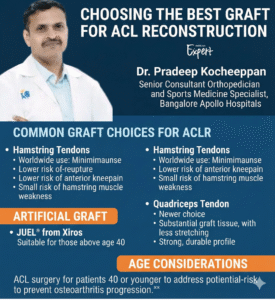
This guide explains the science in simple terms — and includes expert insights from Dr. Pradeep Kocheeppan, Senior Consultant Orthopedician & Sports Medicine Specialist, Apollo Hospitals, Bangalore.
Anterior Cruciate Ligament (ACL) injuries are no longer just a “sports injury”. Today, we see ACL tears in:
Regular gym-goers
Trekking enthusiasts
Weekend cricket/football players
Fitness beginners trying high-impact workouts
After MRI reports show “ACL tear”, most patients worry:
“Do I really need surgery, or can I heal with physiotherapy?”
The truth? Not every ACL tear needs surgery.
But the wrong decision can lead to chronic instability, repeat injuries, and early osteoarthritis. This article explains, in simple language, how to decide.
Can an ACL Tear Heal Without Surgery?
The short answer:
Partial ACL tears may heal in some people with physiotherapy.
Complete ACL tears do not re-grow, but some individuals can still manage without surgery, depending on their lifestyle and sports demands.
Why complete ACL tears don’t “heal back”
The ACL has poor blood supply, and its torn ends do not naturally reconnect.
However, strong surrounding muscles + good neuromuscular control can compensate for a missing ACL in low-demand individuals.
Who can avoid surgery?
| Non-Surgical Treatment Works Well If: | Surgery is Recommended If: |
| Tear is partial | MRI shows complete ACL tear |
| Age > 35 years with low activity | Knee “gives way” during walking, turning, stepping down |
| Daily activities don’t involve pivoting/running | Active in sports (football, badminton, basketball) |
| No episodes of “knee giving way” | Work requires running/jumping (army, police) |
| Physio rehab shows quick improvement | There is associated meniscus tear |
| Meniscus is intact | You had 2 or more instability episodes |
Key Insight:
Repeated “knee giving way” is more damaging than the ACL tear itself because it injures the meniscus and cartilage. That’s how early arthritis begins.
When ACL Needs Surgery (Evidence-based criteria)
When does an ACL Tear Need Surgery?
Not every ACL tear needs reconstruction. The decision is based on instability, not just MRI reports.
Two Simple Tests Decide Better Than MRI
Even if MRI reads “complete ACL tear”, surgery is recommended only if the knee is unstable.
Two clinical tests that matter most:
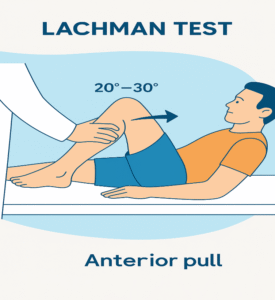
1) Lachman Test
Doctor bends the knee 20–30°
Pulls the shin bone forward
If it slides excessively → ACL is not functioning
What it indicates:
If Lachman grade is 2+ or 3+ (moderate to severe) → Surgery is advised.
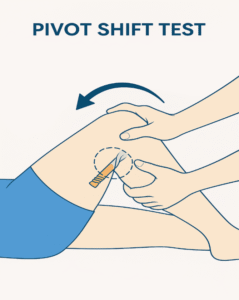
2) Pivot Shift Test
Recreates the twisting force that tears ACL
If knee “gives way” during test → major instability
What it indicates:
If Pivot Shift is positive → ACL reconstruction recommended.
Why physios should care:
Patients with positive Pivot Shift should not be put through aggressive rehab without surgical consultation.
MRI Alone Can Mislead Patients
MRI shows structure, not function.
Many MRIs report dramatic words like:
“Complete ACL tear, Grade III rupture — Reconstruction advised.”
But if there is no instability, the patient may still manage with physiotherapy alone.
Takeaway:
MRI tells how the ACL looks.
Exam (Lachman + Pivot Shift) tells how the ACL behaves.
Surgery Is Recommended When ALL THREE Combine:
| Condition | Interpretation |
| MRI shows complete tear | The ligament is not intact |
| Lachman ≥ Grade 2 | Knee is unstable |
| Pivot Shift positive | Knee “gives way” under twisting |
If all three are present, surgical reconstruction is the best solution.
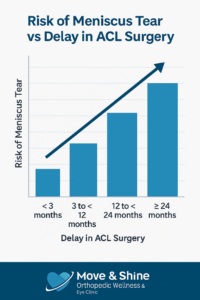
Who Must Avoid Delayed Surgery?
Delay increases risk of meniscus tear + early arthritis, especially in:
Football, Basketball, Badminton players
Police, Military, Fire, Dance, Trekking enthusiasts
< 35 years with active lifestyle
Evidence-Based Fact:
Athletes who delay ACL surgery by > 6 months have 3–6× higher risk of meniscus damage.
Who Benefits from Non-Surgical Rehab?
| Category | Ideal Candidate |
| Age | > 35 years, low activity |
| Work | Desk jobs, non-athletic |
| Sports | No cutting/twisting sports |
| Instability | No episodes of giving way |
| MRI | Partial tear or isolated ACL tear |
Rule of Thumb:
If knee doesn’t “give way during daily life”, try rehab first for 6–12 weeks.
Role of Physiotherapy in Non-Surgical ACL Treatment
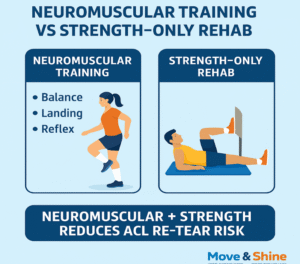
Physiotherapy helps the knee compensate for ACL loss by strengthening:
Quadriceps (especially VMO)
Hamstrings
Glutes
Core stability
Proprioception
Goal: Convert a “surgical candidate” into a stable functional performer without surgery.
Must-Have Rehab Components
| Component | Why it matters |
| Strength | Reduces tibial translation |
| Proprioception | Improves reflex control |
| Landing mechanics | Prevents twisting injury |
| Sport neuromuscular training | Simulates real action |
Types of ACL Surgery Explained Simply
ACL surgery is not a “ligament replacement alone”. Today, surgeons choose techniques based on knee anatomy, sports load, and risk of re-injury.
1) BTB (Bone–Tendon–Bone) Graft
Uses middle layer of patellar tendon
Bone plugs heal firmly inside tunnel
Best for:
Competitive athletes; high pivot sports (football, kabaddi, basketball).
Pros: Strong fixation, excellent stability
Cons: Front knee pain in people who kneel often
2) Hamstring Tendon Graft
Uses semitendinosus ± gracilis
Best for:
General population, low/moderate sports, gym users
Pros: Less front knee pain
Cons: Weaker fixation in high-demand athletes unless augmented
3) Quadriceps Tendon Graft
Thick tendon from top of kneecap
Best for:
Revision ACL, teenagers, multi-ligament injuries
Pros: Thick + strong; less kneeling pain
Cons: New technique; needs expert surgeon
4) Allograft / Artificial Graft
Donor grafts or synthetic grafts
Best for:
Poor tissue quality, revision ACL, multi-ligament injury.
Not ideal for:
Young athletes — higher re-tear risk.
What is ACL+? (Augmentation Procedures Explained Simply)
Sometimes ACL alone is not enough. The surgeon may add extra support to prevent twisting and re-rupture.
When ACL is “not enough”?
Pivot shift is strong
Revision ACL
High-demand pivot sport
Steep tibial slope
Loose joints (ligament laxity)
Young female athletes (higher ACL strain)
Types of ACL+ Add-Ons
| Procedure | Purpose |
| ALL Reconstruction | Controls rotation + pivot |
| Lateral Extra-Articular Tenodesis (LET) | Strengthens outer knee to reduce re-tear |
| Slope Correction Osteotomy | Reduces forward slide of tibia in revision ACL |
Take-home message:
ACL+ is joint preservation, not “extra surgery.”
It protects the graft and reduces arthritis risk long term.
Return to Sport: Criteria-Based, Not Time-Based
Most patients ask: “When can I play again — 6 months?”
The right answer is not a date. It is based on tests.
Return-to-Sport Checklist
Patient should clear these BEFORE returning:
| Test | Requirement |
| Quadriceps Strength | ≥ 90% of opposite leg |
| Hop Test Battery | ≥ 90% symmetry |
| Y-Balance Test | Symmetry achieved |
| No Pain/Swelling | Zero |
| Psychological Readiness | No fear of re-injury |
Evidence shows: Returning without meeting criteria increases re-tear risk by 4–6×, especially in young athletes.
EXPERT COMMENTARY: “Graft Choices — What Patients Must Know”
Senior Consultant Orthopedician & Sports Medicine Specialist, Apollo Hospitals, Bangalore
…………………………………………………………
BTB (Bone–Patellar Tendon–Bone) Graft
Gold-standard graft with excellent fixation using titanium or bio-absorbable screws
Higher incidence of anterior knee pain and difficulty kneeling (important for certain religious practices)
In congenital variations such as patella alta, BTB graft may become too long and difficult to standardize
These limitations are among the reasons surgeons shifted to hamstring grafts
Hamstring Graft
Friendlier graft with less front-knee pain
Slightly higher re-rupture and infection rates
Hamstring weakness post-harvest
In women, graft diameter may not reliably reach 8–8.5 mm, even with multi-strand hamstrings
Quadriceps Tendon Graft
Excellent option for primary and revision ACL
Reliable graft diameter, less stretching, and good healing
Can be taken with or without a bone plug
Even the Best Graft Can Fail
“Any graft — BTB, hamstring, or quadriceps — can fail if knee biomechanics are not corrected or if additional stabilizing procedures (ALL/LET) are ignored when needed.”
Artificial Grafts (e.g., JEWEL from Xiros)
Useful in high-demand older adults or revision surgeries
Promising material performance
Corrected Age Cut-Off for Surgery
“Instead of age 35, we strongly advise 40 years or younger as the proper guideline for ACL reconstruction — not only for returning to sport, but also to prevent early osteoarthritis progression.”