
The hidden risks of the “retail trap“: Why speed and convenience in eye care could be masking serious medical conditions.
In the heart of India’s bustling cities, from Bengaluru to Mumbai, a new trend has taken over the way we look at vision. Walk into any high-end mall or a trendy high-street, and you’ll find sleek, brightly lit optical stores. With “Free Eye Tests” and “15-minute prescriptions,” the promise is simple: speed, convenience, and affordability.
But there is a hidden cost to this convenience. At Move & Shine, we are seeing an alarming rise in patients coming to us with persistent headaches, “wrong” prescriptions, and most tragically, advanced stages of diseases like Glaucoma or Macular Degeneration that were completely missed during a “counter-top” eye test.
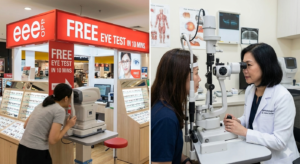
1. The “Fast-Food” Approach to Eye Care: The Retail Trap
The Indian consumer is naturally value-conscious. When a brand offers a “home eye test” for ₹99 or a free test at a kiosk, it sounds like a win-win. However, it is essential to understand the business model. Retail optical chains are primarily retail businesses, not medical clinics. Their goal is to sell frames and lenses. The “eye test” is often used as a “lead magnet”—a way to get you through the door.
What’s missing at the counter?
The Clinical Environment: A proper eye exam requires controlled lighting and specific distances that most kiosks cannot replicate.
The Human Element: Often, the person testing your eyes is a “Refractionist” with basic machine training, not a qualified Optometrist or an Ophthalmologist like Dr. Donna Susan.
The Medical History: A specialist asks about your diabetes, blood pressure, and family history. A counter-test usually only asks, “Can you read the bottom line?”
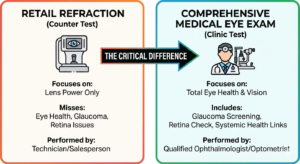
2. Refraction is NOT an Eye Exam
This is the most significant misunderstanding in India today. People use the terms “eye test” and “eye exam” interchangeably. They are fundamentally different.
Refraction (The “Counter” Method): This is a simple measurement of how light bends as it enters your eye. It tells you what power of lens you need to see clearly. It is purely mechanical.
Comprehensive Eye Exam (The “Medical” Method): This is a medical assessment of the health of the eye. It includes refraction, but it also looks at the retina, the optic nerve, intraocular pressure, and the health of the blood vessels.
Dr. Donna Susan’s Insight: “I often see patients who have changed their glasses three times in a year because ‘the number didn’t feel right.’ When they finally come to Move & Shine, we realize the problem isn’t the prescription—it’s early-stage Cataracts or fluctuating sugar levels. A machine can’t tell you why your vision is blurry; it can only mask the blur with a lens.”
3. The Hidden Dangers: What a Counter Test Misses
When you bypass a specialist, you skip the screening for several “silent killers” of vision.
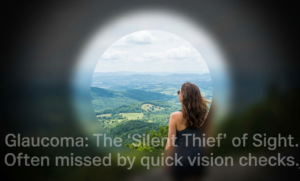
A. Glaucoma: The Silent Thief
Glaucoma is a leading cause of irreversible blindness in India. It often has no symptoms until vision is already lost. A retail counter almost never checks your Intraocular Pressure (IOP). By the time a “counter test” realizes you can’t see well, the damage may be permanent.
B. Cataracts vs. Simple Power Changes
As we age, our lenses naturally cloud. In the early stages, this can feel like a simple shift in prescription. A retail salesperson will happily sell you new glasses, but a specialist will identify the cataract and prevent you from wasting money on lenses that will soon be useless.
4. Why “Quick and Easy” Costs More in the Long Run
The Wrong Fit: Inaccurate measurements of Pupillary Distance (PD) cause “swim effect,” dizziness, and nausea.
Product Overkill: Retailers are trained to upsell “Blue-Cut” coatings you may not need. A doctor-led clinic prescribes based on medical necessity.
Delayed Diagnosis: Missing conditions like Keratoconus (corneal thinning) in a young adult can lead to the need for a corneal transplant later in life.
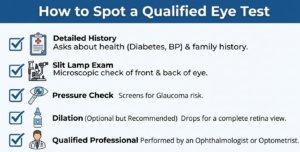
5. Checklist: How to Spot a “Qualified” Eye Test
If you are getting your eyes checked, ensure these steps are taken. If they are missing, you are at a retail counter, not a medical clinic.
6. The Indian Context: The “Chalta Hai” Attitude
In India, we treat blurry vision like a headache—something a quick fix can solve. However, the rise of unregulated refraction counters in malls and pharmacies is a major public health risk. These kiosks often use equipment that hasn’t been calibrated, leading to massive errors in prescriptions, especially for children.
7. The Move & Shine Approach: Medical-First Vision Care
At Move & Shine, led by Dr. Donna Susan, our eye care philosophy is integrated with our overall wellness mission.
Preventive Focus: We want to ensure you keep your natural sight for life.
Advanced Diagnostics: Our facility is equipped with medical-grade tools that go far beyond a simple “Auto-Refractor.”
Integrated Care: If your eye issues are linked to posture (Physio) or systemic health, our team works together to treat the cause, not just the symptom.
Frequently Asked Questions (FAQs)
1. I just got a “Free Eye Test” at a mall. Why do I still need a specialist?
A kiosk test is usually a refraction-only check. It doesn’t check your retina or eye pressure. At Move & Shine, we screen for silent diseases a kiosk will miss.
2. Is there a difference between a “Refractionist” and an “Ophthalmologist”?
Yes. Refractionists are trained only to operate a machine. An Ophthalmologist is a medical doctor who can diagnose diseases that a machine cannot see.
3. I bought glasses online, but I’m getting headaches. Why?
This is often due to an incorrect Pupillary Distance (PD). If the lens isn’t perfectly aligned with your pupil, your eyes have to “pull” to see clearly.
4. Can a computer-generated eye test be wrong?
Absolutely. Auto-refractors can be fooled by eye fatigue. A specialist uses subjective refraction to cross-verify the machine’s findings with your actual comfort.
5. My vision is 6/6 (20/20). Does that mean my eyes are healthy?
Not necessarily. You can have 6/6 vision and still have early-stage Glaucoma or a Retinal Tear.
6. Why does Dr. Donna Susan suggest “Dilation” (eye drops)?
Dilation is the only way a doctor can see the entire retina and the optic nerve. Retail shops avoid it because it takes time and makes vision blurry for a few hours.
7. Are “Blue-Cut” lenses actually necessary?
These are often a retail upsell. We analyze your Visual Hygiene first. Sometimes, you don’t need a coating; you need better ergonomics.
8. Why should I avoid “Home Eye Tests”?
Home environments lack standardized lighting. More importantly, portable equipment cannot perform a Slit-Lamp Examination to check for inflammation or cataracts.
9. Can a child get their eyes tested at a retail counter?
We strongly advise against it. Children’s eyes can “cheat” a machine. A Pediatric Eye Exam requires special drops to get a true, accurate reading.
10. I have Diabetes. Is a mall eye test enough?
Never. Diabetic Retinopathy requires a specialist to examine the tiny blood vessels at the back of the eye.
Conclusion: Invest in Vision, Not Just Frames
The next time you are tempted by a “Free Eye Test” at a mall, ask yourself: “Is my sight worth the shortcut?” Eyewear is a fashion statement, but eye health is a life necessity.
Visit Dr. Donna Susan at Move & Shine for a comprehensive, medical-grade eye evaluation.

