Why Visual Fitness is the Hidden Game-Changer for Indian Athletes
India is in the middle of a massive sporting revolution. From the maidans of Mumbai to the shooting ranges of Haryana and the badminton academies of Hyderabad, the competition is fiercer than ever. Aspiring athletes are spending hours in the gym, perfecting their nutrition, and refining their technique. We see parents investing heavily in top-tier cricket kits, professional coaching, and high-protein diets.
But there is a “silent” skill that separates the good from the great—a skill that is often completely ignored until it becomes a problem:
At Move & Shine Orthopaedic Wellness & Eye Clinic, we often see athletes who are physically at their peak but are held back by a split-second delay in reaction. They aren’t slow; their eyes are just not processing information fast enough.
We askedDr. Donna Susan, our specialist Ophthalmologist, why this happens so often in young athletes.

“Most athletes think ’20/20′ or ‘6/6’ vision is enough. It is not. In high-performance sports, you don’t just need to see clearly; you need to process speed, depth, and contrast faster than your opponent. Your eyes are the first line of defence and the first point of attack. If your visual system is slow, your feet will be slow, no matter how much you train.”
If you can’t see it, you can’t hit it, catch it, or stop it. This guide delves deep into why Indian athletes must prioritize eye health and how “Visual Fitness” is the next frontier in sports performance.
Visual Demands in Indian Sports: It’s More Than Just Clear Sight
Different sports make different demands on your visual system. In the Indian context, where sports like Cricket, Badminton, and Shooting dominate, the visual load is immense.
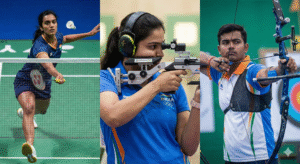
Let’s break down the specific visual skills required for the sports we love.
1. Cricket: The Art of High-Speed Tracking
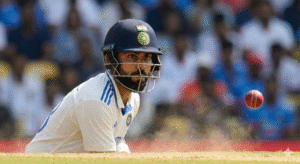
Cricket is perhaps the most visually demanding sport in the world. Consider a batsman facing a fast bowler delivering at 140 kmph.
The Challenge: The ball travels the pitch in under 0.5 seconds. In that fraction of a time, the batter must judge the speed, the line, the length, and the swing.
Visual Skill Required:
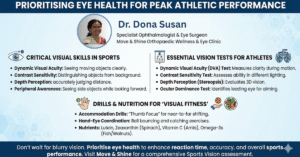
Dynamic Visual Acuity: The ability to see objects clearly while they are moving fast.
Depth Perception: Judging exactly where the ball will pitch.
Saccadic Eye Movement: The ability of the eyes to “jump” quickly from the bowler’s hand to the pitch of the ball.
Indian Context: On dusty or wearing Indian pitches, the ball often behaves unpredictably. If your contrast sensitivity (ability to distinguish objects from their background) is poor, you will struggle to pick the red ball against a brownish crowd or a dusty background.
2. Badminton: Reaction Time at the Net
Indian shuttlers are ruling the world, and the game has become incredibly fast.
The Challenge: A shuttlecock smash can exceed 400 kmph. At the net, the reaction time available is practically zero.
Visual Skill Required:
Visual Reaction Time: The speed at which your brain interprets the image and signals your hand to move.
Accommodation: The ability to change focus instantly from far (opponent’s baseline) to near (the net).
Dr. Donna Susan notes a specific issue common in racquet sports:
“We frequently hear badminton and tennis players who complain of ‘losing the shuttle’ under floodlights. This isn’t just glare; it is often a Contrast Sensitivity issue. When the contrast is poor, your brain takes microseconds longer to identify the object. In a game like Badminton, those microseconds are the difference between a winner and an unforced error.”
— Dr. Donna Susan
3. Shooting & Archery: The Stillness of Focus
With India’s immense success in Olympic shooting, more kids are taking up the sport.
The Challenge: Hitting a bulls-eye requires intense, sustained concentration without visual fatigue.
Visual Skill Required:
Visual Endurance: Maintaining focus without the vision blurring or “tearing up.”
Dominant Eye Stability: Knowing which eye is dominant is critical for aiming. Cross-dominance (e.g., right-handed but left-eye dominant) can severely hamper accuracy if not corrected or trained.
4. Motorsports: The Wide Field of View
With circuits like BIC (Buddh International Circuit) and growing interest in karting, motorsports is rising.
The Challenge: A driver cannot look just at the road ahead; they must be aware of cars trying to overtake from the blind spots.
Visual Skill Required:
Peripheral Awareness: Seeing what is happening on the sides while looking straight ahead. This is crucial for avoiding crashes.
Beyond the 6/6 Chart: What Tests Do Athletes Actually Need?
Most school or standard eye exams only test for Static Visual Acuity (the ability to read letters on a stationary chart). This is useless on a football field or cricket pitch.
Specific Sports Vision assessments:
Dynamic Visual Acuity (DVA) Test: Measures clarity when the object is moving. (Crucial for fielders).
Contrast Sensitivity Test: Tests ability to see objects against similar backgrounds (White ball against grey sky).
Depth Perception (Stereopsis): Measures how both eyes work together to judge distance.
Ocular Dominance Test: Identifying the “leading” eye for aiming sports.
Train Your Eyes: Simple Drills for Better
Just like you do push-ups for your chest, you can do drills for your eyes. Here are three simple exercises you can do at home or during warm-ups.
Drill 1: The “Thumb Focus” (Accommodation): Hold your thumb at arm’s length. Focus on the nail. Quickly switch focus to an object 20 feet away. Switch back. Repeat 20 times.
Drill 2: Ball Bouncing (Hand-Eye Coordination): Throw a tennis ball against a wall with your right hand and catch with your left. To level up, have a partner throw it from behind you so you react only to the rebound.
Drill 3: Peripheral Expansion: Focus on a point on the wall. Without moving your eyes, try to identify objects at the extreme left and right of the room.
Nutrition for the “Indian Athlete’s Eye”
You cannot out-train a bad diet. Your eyes require high levels of antioxidants to repair the stress of UV exposure and intense focus.
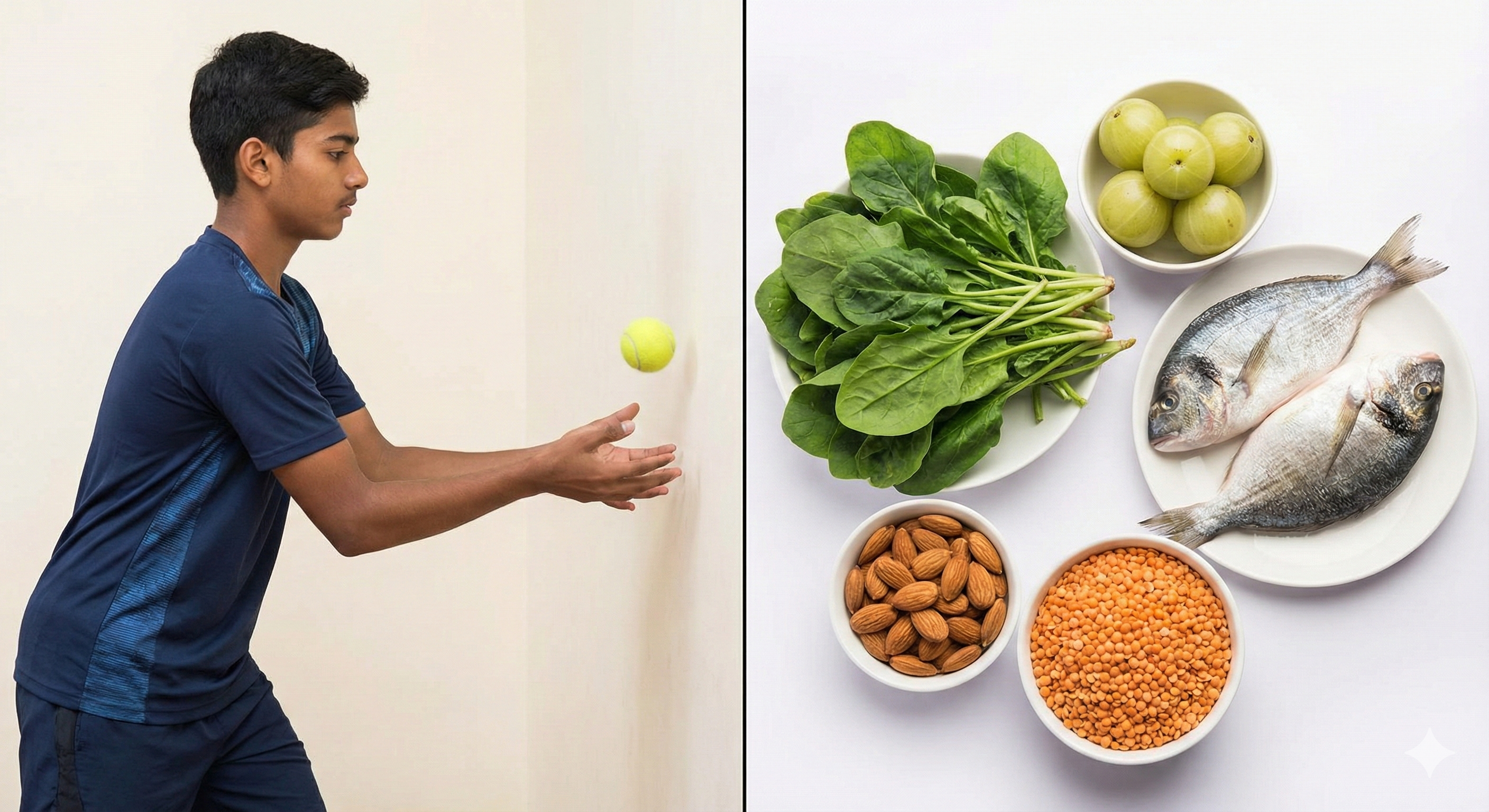
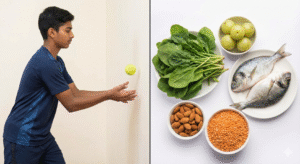
Lutein & Zeaxanthin: Palak (Spinach), Methi (Fenugreek), and Curry Leaves.
Vitamin C: Amla (Indian Gooseberry) is the best source.
Omega-3 Fatty Acids: Fish, Flaxseeds (Alsi), and Walnuts (Akhrot).
Zinc: Dal (Lentils), Chickpeas (Chana), and Pumpkin Seeds.
According to Dr. Susan, individuals who aren’t getting adequate amounts of these antioxidants and vitamins should strongly consider bioavailable supplements like liposomal vitamin C or high-strength omega-3s to support optimal eye health.
The “Move & Shine” Advantage: Why Elite Athletes Choose Us
You might ask, “Why should I go to Move & Shine for my eyes? Can’t I just go to a regular optical shop?”
The difference lies in our DNA. Move & Shine is not just a clinic; it is a performance hub frequently visited by elite sportsmen—national-level Hockey players, Judo champions, professional Swimmers, and Footballers.
The Integrated Approach
The human body is connected. A neck injury can affect visual stability. A balance issue can stem from vision.
At Move & Shine, you get a holistic evaluation:
Dr. Pradeep Kocheeppan (Senior Consultant in Orthopedics & Sports Medicine) handles the structural and injury recovery aspect.
Dr. Viresh Murugodimanages Sports Medicine and Supervise Physiotherapy and rehabilitation programs.
Dr. Donna Susan integrates the visual performance aspect.
This unique collaboration allows us to understand the athlete’s complete physiology. As Dr. Donna Susan puts it:
“At Move & Shine, we don’t just treat patients; we treat performers. Because we handle their orthopedic recovery, we know their weaknesses. We know if a footballer is hesitant to head the ball, it might be a visual tracking issue, not fear. When Dr. Pradeep or Dr. Viresh identifies a balance issue in an athlete, we immediately check the visual system. That integrated problem-solving is what gives our athletes the winning edge.”
— Dr. Donna Susan