You Feed Your Muscles, But Do You Feed Your Eyes?
In the diverse landscape of Indian sports and fitness, we are currently witnessing a “Nutrition Revolution.” Every gym-goer in Bengaluru knows about “macros.” Cricket academies in Mumbai and Delhi have nutritionists planning detailed charts for muscle recovery, focusing heavily on protein for biceps and carbohydrates for stamina. We see parents packing almonds and protein shakes for their children before practice.
But there is a critical organ that is often completely starved in this fitness regime: The Eye.
Your eyes are the most energy-demanding organs in your body relative to their size. They consume massive amounts of oxygen and nutrients to process millions of bits of information per second. When a batsman tracks a spinner’s delivery, or when an IT professional scans lines of code for 10 hours, the eyes are under immense metabolic stress.
At Move & Shine Orthopaedic Wellness & Eye Clinic, we frequently encounter a specific type of patient: the “physically fit but visually fatigued” athlete. These are individuals who can run a marathon or bowl 10 overs without tiring, yet they suffer from dry eyes, slow reaction times in low light, and debilitating glare sensitivity.

The culprit? Often, it is a diet that lacks specific “ocular nutrients.”
We asked Dr. Donna Susan, our Specialist Ophthalmologist, why this gap exists in sports nutrition.

“Patients often come to me asking for ‘better glasses’ because they struggle with glare under floodlights or feel their vision fluctuates during a match. I tell them: Glasses only correct the focus. They don’t correct the health of the retina. Think of nutrients like Lutein and Zeaxanthin as ‘internal sunglasses.’ If you don’t eat enough of them, your retina lacks the protective pigment to filter out harsh light. The solution isn’t just a new lens—it’s a better diet.” — Dr. Donna Susan
This guide goes beyond the basic “eat carrots” advice. We break down the science of neuro-visual nutrition, specifically tailored for the Indian palate, to help you build “high-definition” vision.
The Science: How Food Affects Contrast, Glare, and Neuromuscular Coordination
You might ask, “Can eating a bowl of spinach really help me catch a fast ball better?” The answer lies in the biochemistry of the eye. It is not just about “seeing clearly” (acuity), which is static; it is about Visual Performance, which is dynamic.
1. Contrast Sensitivity & The Macula
The macula is the center of your retina, responsible for sharp, detailed vision. It contains a yellow pigment composed of Lutein and Zeaxanthin. This pigment acts like a filter.
The Mechanism: Higher pigment density absorbs excess blue light and reduces “chromatic aberration” (blur).
The Sport Result: Improved Contrast Sensitivity—the ability to spot a white shuttlecock against a white wall or a red cricket ball against a brownish-green pitch.
The Daily Life Result: Better ability to see curbs and steps at night.
2. Glare Recovery
This is how fast your vision returns to normal after looking into a bright light (like a car headlight or stadium floodlight).
The Mechanism: When light hits your eye, pigments “bleach” to send a signal to the brain. They must regenerate instantly for the next image.
The Sport Result: A fielder looking into the sun to catch a high ball needs instant recovery to see where to throw it next.
3. Neuromuscular Coordination (Reaction Time)
This is the time it takes for the signal to travel from the retina, through the optic nerve, to the visual cortex, and finally to your muscles.
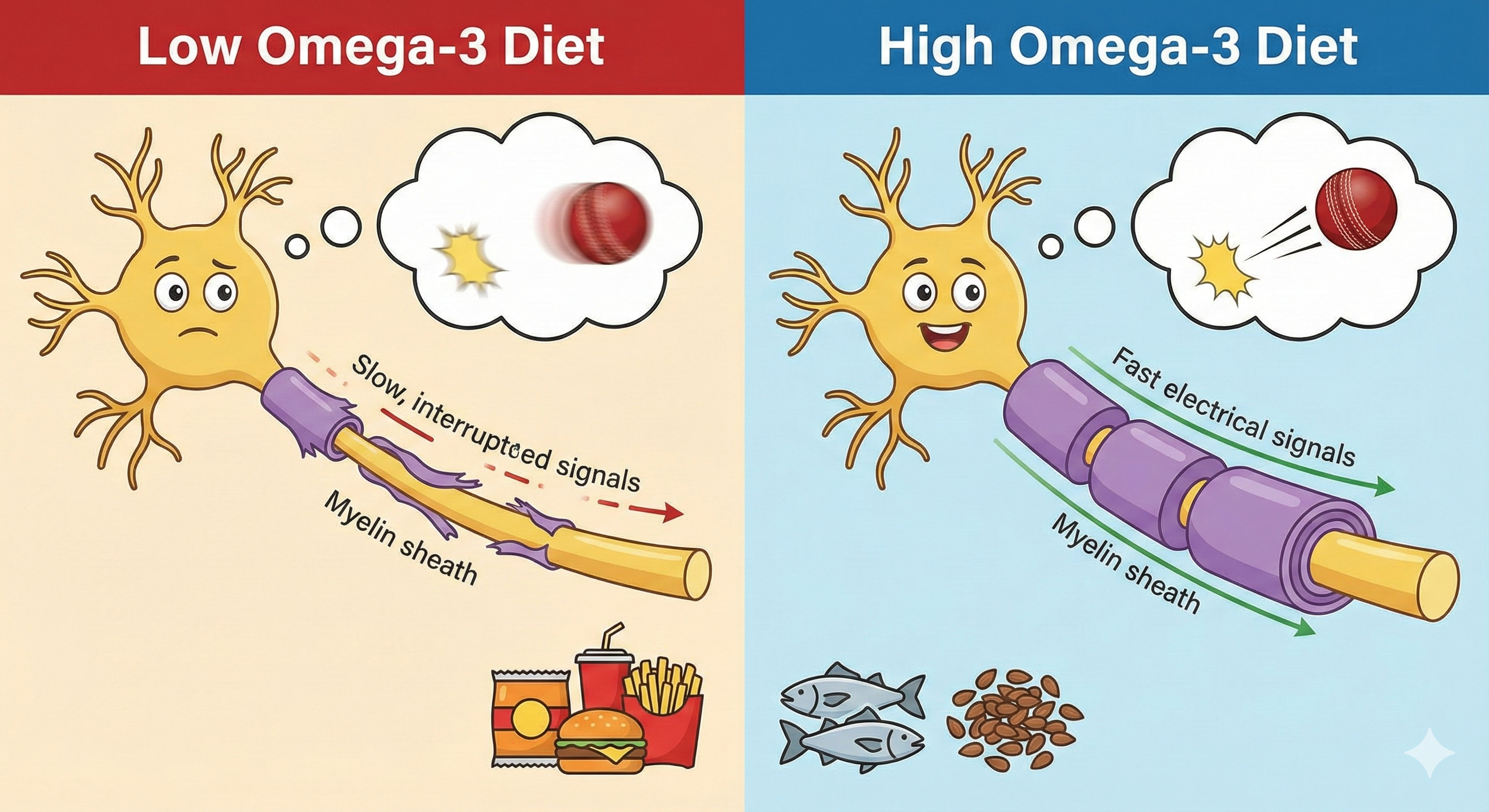
The Mechanism: The optic nerve is insulated by a fatty sheath called myelin.
The Sport Result: This dictates your Reaction Time. If the insulation is poor (lack of Omega-3s), the signal is slower.
The “Eye-Fuel” Checklist: Essential Nutrients
Forget exotic berries and imported kale. The best foods for your eyes are likely already in your local sabzi mandi or your grandmother’s kitchen.
1. Lutein & Zeaxanthin (The “Internal Sunglasses”)
These are carotenoids that the body cannot make; you must eat them. They accumulate in the macula and absorb harmful blue light.
Why Athletes Need It: Crucial for cricketers and fielders tracking objects against bright skies.
Best Indian Sources:
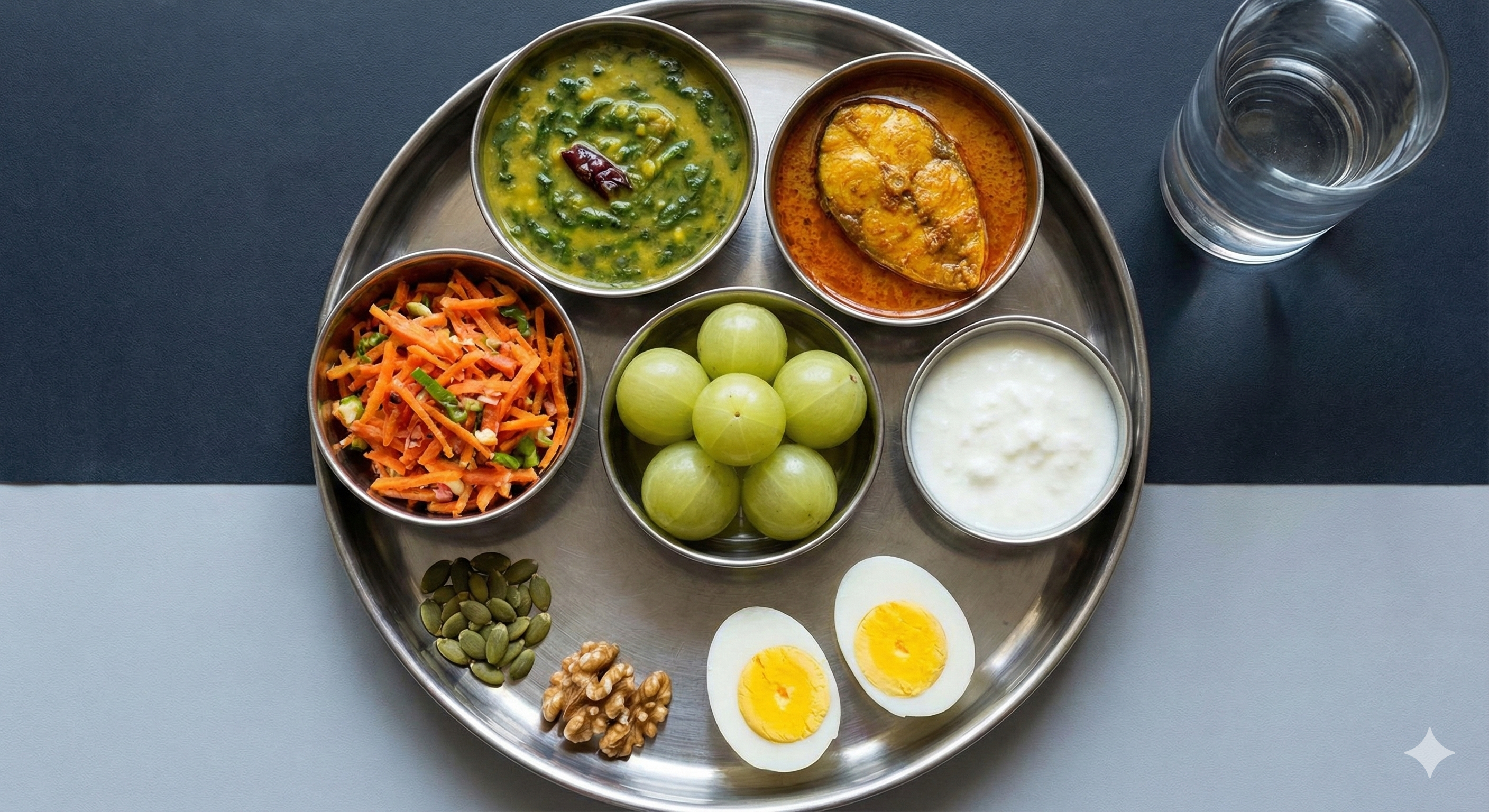
Moringa (Drumstick Leaves): A hidden Indian superfood. Moringa leaves contain significantly higher Lutein than many western greens.
Palak (Spinach) & Methi (Fenugreek): Classic winter staples in India.
Curry Leaves: Don’t pick them out of your sambar and throw them away! They are rich in antioxidants.
Egg Yolks: The yellow color is pure lutein. Athletes often throw away the yolk to avoid fat—for your eyes, this is a mistake. Eat the whole egg.
2. Omega-3 Fatty Acids (The “Lubricant & Insulator”)
Your retina has the highest concentration of DHA (a type of Omega-3) in the body. Omega-3s are also powerful anti-inflammatories.
Why Athletes Need It: To prevent “Dry Eye Syndrome.” In India’s dusty environment, dry eyes cause vision to fluctuate and blur during long matches.
Best Indian Sources:
Fatty Fish: Rohu, Hilsa, and Mackerel (Bangda) are excellent local sources.
Vegetarian Sources: Flaxseeds (Alsi), Chia seeds, and Walnuts (Akhrot). Pro-tip: Roast flaxseeds and add them to your daily chutney or dal.
“I treat many IT professionals and gamers who complain of ‘tired eyes’ by 4 PM. This is often dry eye caused by tear evaporation. Omega-3 fatty acids improve the oil layer of the tear film, keeping the eye moist. A moist eye is a sharp eye. If your eye is dry, the surface becomes irregular, and your vision scatters.” — Dr. Donna Susan
3. Vitamin C (The “Shield”)
The eye has a high metabolic rate, creating “rust” (oxidative stress). Vitamin C protects against this and delays cataracts.
Why Athletes Need It: Keeps the blood vessels in the eye healthy, ensuring steady oxygen supply during intense activity.
Best Indian Sources:
Amla (Indian Gooseberry): The king of Vitamin C. One Amla equals 20 oranges.
Guava (Amrood): Far better than imported kiwis.
Capsicum: Add it to your salads.
4. Vitamin A & Zinc (The “Night Vision” Crew)
Vitamin A creates the pigment rhodopsin, which helps you see in low light. Zinc transports Vitamin A from the liver to the eye.
Why Athletes Need It: Essential for driving at night or playing sports in fading light (dusk).
Best Indian Sources:
Carrots & Sweet Potato (Shakarkandi): For Vitamin A.
Pumpkin Seeds & Chickpeas (Chana): High in Zinc.
5. Protein & Vitamin D (The Muscle Support)
We forget that the eye is controlled by muscles. The Extraocular muscles move the eye, and the Ciliary muscle changes focus.
Why Athletes Need It: To prevent “focus fatigue.” If your ciliary muscle gets tired, you can’t switch focus from the ball to the boundary line quickly.
Best Indian Sources:
Dal/Lentils, Paneer, Chicken, and Eggs.
Sunlight: Vitamin D deficiency is rampant in India and is linked to Macular Degeneration.
Meal Timing: When to Eat for Visual Performance
Nutrition isn’t just what you eat, but when.
Hydration (30 Mins Before Sport): Even 2% dehydration reduces tear volume. Drink 500ml water.
The Pre-Game Meal (2 Hours Before): Avoid heavy carbs that cause a “sugar crash.” A sugar crash causes blurred vision. Stick to complex carbs like Oats or Ragi.
Post-Game Recovery: High antioxidant foods (Amla juice or a fruit bowl) to repair the oxidative stress caused by UV exposure during the game.
The “Move & Shine” Advantage: Integrated Nutrition
Why choose Move & Shine Orthopaedic Wellness & Eye Clinic for advice on performance? Because we don’t treat the eye in isolation. We understand that Neuromuscular Coordination is a full-body event.
Dr. Pradeep Kocheeppan (Orthopedics) ensures your neck and spine allow for stable head movement.
Dr. Viresh Murugodi (Physiotherapy) works on your balance and reaction speed.
Dr. Donna Susan (Eye Care) ensures your visual hardware is fueled and focused.
If a cricketer has a slow reaction time, it could be a weak rotator cuff (Ortho issue) OR it could be slow visual processing due to poor diet (Eye issue). Our team figures out the root cause together.
“We can prescribe the best contact lenses in the world, but if an athlete is malnourished or dehydrated, their visual system will fail under pressure. At Move & Shine, we look at the whole picture—Ortho, Physio, and Vision—to build a complete athlete.” — Dr. Donna Susan
FAQs: Critical Questions on Eye Nutrition