
From Gulli-Danda to Gaming Consoles
If you look at a school photograph from the 1990s in India, you might spot one or two children wearing glasses in a class of forty. It was often a distinguishing feature, sometimes even a source of playground teasing. Fast forward to 2024. Walk into a typical classroom in Bengaluru, Mumbai, or Delhi, and the picture has drastically inverted. In many top-tier urban schools, nearly 50% of the students are peering at the blackboard through spectacles.
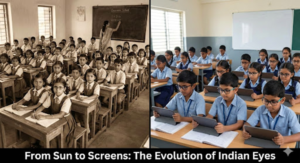
This visual transformation isn’t just your imagination, and it isn’t limited to fashion trends. We are in the midst of a global health shift, often termed the “Myopia Epidemic.” While glasses have become a common accessory—normalized by Harry Potter and stylish frames—the medical reality behind them is concerning. The rise in Myopia (nearsightedness) is not just about blurred distance vision; it is a signal that our modern lifestyle is fundamentally altering the anatomy of our eyes. The human eye, which evolved over millions of years to scan horizons and hunt in sunlight, is struggling to adapt to a world that exists within arm’s reach.
At Move & Shine Orthopaedic Wellness & Eye Clinic, we believe in addressing the root cause, not just the symptom. This guide explores why India is becoming more bespectacled, the hidden “axial” dangers of this shift, and why the old approach of “just buying stronger glasses” is no longer enough.
The “Myopia Boom”—A Silent Crisis in Numbers
For decades, ophthalmologists believed eyesight was purely a roll of the genetic dice—if your parents wore glasses, you would likely wear them too. While genetics provides the blueprint, the speed of this current rise points undeniable fingers at our environment.
The Global & Indian Reality:
The 2050 Prediction: The World Health Organization (WHO) and the Brien Holden Vision Institute predict that by the year 2050, half the world’s population (5 billion people) will be myopic.
The Urban Indian Surge: Studies indicate that myopia prevalence in urban Indian children has jumped from approximately 4.4% in 1999 to over 21% in 2019. In highly academic environments (medical/engineering coaching hubs), this number is even higher.
The COVID Accelerator: The pandemic acted as a catalyst. With “Online Schooling” becoming the norm for two years, children spent critical developmental years glued to screens indoors. We are now seeing the fallout of those two years: a generation with eyes that aged faster than they should have.

Dr. Donna Susan’s Insight: “We are witnessing a ‘myopic shift’ in children as young as four or five. Ten years ago, a 5-year-old with minus power was a clinical rarity. Today, it’s a weekly occurrence in my clinic. Parents often ask, ‘Is his number weak?’ I have to explain: It’s not just weak; the eye is physically elongating. It is growing too long due to excessive strain and lack of natural light.”
The Mechanics of the Blur (How Myopia Happens)
To understand why this is dangerous, we must move beyond the idea of “blur.” In a perfect eye (Emmetropia), light enters through the pupil and focuses precisely on the retina (the back of the eye). In a Myopic eye, the eyeball grows too long (Axial Elongation). Think of it like a camera where the film has been moved too far back from the lens. The light focuses in front of the retina, causing distant objects to look blurry.
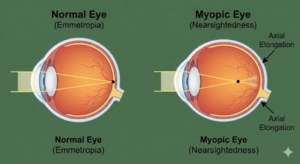
Why does the eye grow long? The eye is a smart organ. When you spend 10 hours a day focusing on a book or screen 30cm away, your eye attempts to adapt to this environment. It elongates to make near-work easier. Essentially, your body is physically changing its shape to become a “near-work device.”
The “Indian Context”—Why We Are Hit Harder
India’s unique social, academic, and urban landscape creates a “Perfect Storm” for myopia progression.
The “Tuition Culture” & Academic Pressure: In India, the pressure to perform starts early. Between regular school (8 AM – 3 PM), homework, and the ubiquitous “evening tuition,” the average Indian child spends 8–12 hours a day on “near work.”
The “Vitamin D” Deficit (The Vanishing Outdoors): It isn’t just what children are doing; it’s what they aren’t doing. Research has conclusively proven that Dopamine—a neurotransmitter released in the retina—acts as a “stop signal” for eye growth. The trigger for Dopamine? Bright, natural sunlight.
The Screen-Sitter Generation: From toddlers being fed meals while watching Cocomelon on YouTube to teenagers scrolling Instagram reels, screens are everywhere.
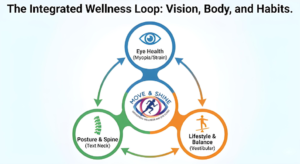
The Integrated Wellness Perspective (The Move & Shine Advantage)
This is where Move & Shine differs from a standard optical shop. We understand that your eyes are attached to a body, and that body is suffering from the same lifestyle issues.
The Eye-Spine Connection: You cannot separate vision from posture. When a child (or IT professional) leans forward to look at a screen, they engage in “Forward Head Posture.”
Dr. Pradeep Kocheeppan (Orthopedics) notes: “We are seeing a correlation between early onset cervical spondylosis (neck issues) and vision problems. When the neck muscles are tight, they restrict blood flow to the head and cause tension headaches.”
The Vestibular Mismatch: Mr. Rohit Kiran – Performance Enhancement: “When you scroll rapidly on a screen, your eyes see movement, but your inner ear (balance system) feels you are sitting still. This conflict causes low-grade nausea and dizziness, often called Cybersickness.”
Our integrated therapy helps reset this balance through vestibular exercises and ergonomic correction.”
At Move & Shine, a vision check is often the first step in diagnosing a broader lifestyle dysfunction.
The Hidden Cost—Why “Fixing It” Isn’t Enough
The traditional mindset is: “If the child can’t see, buy them glasses. Problem solved.” This is Passive Correction. It fixes the blur, but it does nothing to stop the disease mechanism.
The Danger of High Myopia: When the eye grows too long, the retina stretches and thins, increasing the risk of:
Retinal Detachment: The risk is 5x to 6x higher.
Glaucoma: The optic nerve is more susceptible to pressure damage.
Cataracts: They tend to develop 10-15 years earlier in high myopes.
Expert Warning:
“Buying glasses without managing the progression is like putting a bucket under a leaking roof but never fixing the hole. The water (the power) will keep rising until it causes structural damage.” — Dr. Donna Susan
The New Standard—Active Myopia Management
We are moving away from Passive Correction to Active Myopia Management. We don’t just want to help your child see today; we want to save their vision for tomorrow.
- The Lifestyle Prescription: “Green Time”
We prescribe “Green Time” just as seriously as we prescribe eye drops.
- The Golden Rule: A minimum of 90 to 120 minutes of outdoor time daily. This doesn’t mean playing sports; just being outside in natural light (even in the shade) triggers the dopamine defense.
- The 20-20-20 Rule: Every 20 minutes of reading, look 20 feet away for 20 seconds. This relaxes the ciliary muscles that lock up during near work.

- Pharmacological Intervention (Atropine Therapy)
For children whose power is jumping rapidly, Dr. Donna Susan may prescribe Low-Dose Atropine Eye Drops (0.01% to 0.05%).
- How it works: It chemically signals the sclera (white part of the eye) to stop stretching.
- The Experience: It does not sting, causes minimal pupil dilation, and does not affect near reading. It is currently one of the most effective, evidence-based ways to slow progression.
- Specialized Optical Control (DIMS/HAL Technology)
Standard glasses correct vision at the center but actually cause light to blur behind the retina at the edges (peripheral hyperopic defocus), which stimulates eye growth.
- The Solution: We use specialized lenses (like Stellest or MiYOSMART). These have a clear center zone for sharp vision, surrounded by hundreds of tiny “dimples” that create a protective defocus signal for the eye. Clinical trials show these can slow down power progression by 60%.
Not Just Kids—The “Bespectacled” Adult
While children are the primary concern, adults are not immune.
Digital Eye Strain (Computer Vision Syndrome):
Adults often experience “False Myopia.” After a 12-hour workday, you might feel like your distance vision is blurry. This is often a spasm of the focusing muscles.
At Move & Shine, we treat this with:
- Lubrication therapy for Dry Eye (which blurs vision).
- Anti-Fatigue Lenses: These have a small “boost” zone at the bottom of the lens to help your tired eyes read without straining.
- Office Ergonomics: Adjusting screen height to protect the neck and eyes simultaneously.
FAQs : Questions Every Indian Parent Asks
Q1: My child is only 5 years old. Is it too early for glasses?
A: No. If a child needs glasses and doesn’t wear them, the brain may permanently stop processing images from that eye. This is called Amblyopia or “Lazy Eye.” Fixing it becomes impossible after age 7 or 8.
Q2: Will wearing glasses make my child’s number increase faster?
A: This is a common myth. The opposite is true. Not wearing glasses strains the eyes, forcing them to squint and work harder, which often accelerates the increase in power.
Q3: Can eating carrots, almonds, or taking supplements remove the need for glasses?
A: No. While Vitamin A and Omega-3s are essential for retinal health, no amount of carrots will reshape an eyeball that has grown too long physically. Diet supports health; it does not correct refractive error.
Q4: Is it safe for my teenager to wear contact lenses?
A: Yes, provided they are responsible. We recommend Daily Disposable lenses for hygiene. They are excellent for sports and boosting self-confidence.
Q5: What is “Blue Light” and do we really need Blue Cut lenses?
A: Blue light from screens affects sleep cycles. While Blue Cut lenses are popular marketing, they are not a magic cure for eye strain. Taking breaks and blinking is far more effective. We recommend them mostly for people who use screens late at night.
Q6: Can Lasik surgery fix my child’s eyes now?
A: No. Lasik is a contouring surgery for the cornea. It can only be performed after age 18-21, once the eye power has stabilized for at least a year. Doing it on a growing eye is dangerous.
Q7: How often should we check the power?
A: For children, every 6 months is mandatory because they go through growth spurts. For adults, once a year is sufficient unless you have diabetes.
Q8: If both parents have perfect vision, can the child still get glasses?
A: Yes. Environmental factors are now just as powerful as genetics. We see many “first-generation” myopic children in our clinic—the first in their family to need glasses due to lifestyle.
Q9: What is the “ideal” distance for reading or using a tablet?
A: The Harmon Distance: The distance from the child’s elbow to their middle knuckle. Generally, nothing should be closer than 30-40 cm from the eyes.
Q10: Can Yoga or eye exercises (Trataka) cure myopia?
A: Yoga helps relax the mind and body, and eye rotation exercises can relieve muscle stiffness. However, they cannot shrink the eyeball back to its original shape. They are complementary therapy, not a cure.
Conclusion: Don’t Wait for the Squint
The rising tide of spectacles in India is a wake-up call. It is a sign that our environment has become visually demanding. But with early intervention, we can ensure that a pair of glasses remains just a tool for clear sight, not a precursor to lifelong eye disease.
Vision care is no longer just about reading letters on a wall chart. It is about how you live, how you sit, and how you play.
Your Action Plan:
- Observe: Does your child hold books too close, rub their eyes frequently, or complain of headaches?
- Act: Schedule a comprehensive eye exam (cycloplegic refraction) to get the true picture.
- Prevent: Enforce the “90 Minutes Outdoors” rule starting today.
Is your family due for a vision check?
Don’t rely on basic school screenings. Book a Comprehensive Integrated Eye Evaluation at Move & Shine Orthopaedic Wellness & Eye Clinic today. Let Dr. Donna Susan, Dr. Pradeep, and the team help you protect your vision and your wellness.

