The human shoulder is a marvel of biological engineering. It is the most mobile joint in your body, allowing you to reach overhead, swing a golf club, or simply scratch your back. However, this incredible range of motion comes at a price: instability. Because the joint relies so heavily on muscles and ligaments rather than deep bone-to-bone sockets, it is incredibly susceptible to injury.
shoulder pain causes and treatment
In today’s fast-paced world, shoulder pain has become an almost universal experience. Whether it is the result of a “tech neck” posture from hours at a computer, a sudden tweak during a weekend cricket match, or the repetitive strain of household chores, shoulder issues can quickly transition from a minor annoyance to a debilitating condition. Many people make the mistake of “pushing through” the pain, only to find that what started as a simple strain has evolved into a complex rotator cuff tear or a rigid frozen shoulder.
At Move and Shine Clinic in Bangalore, we specialize in orthopedic wellness and physiotherapy rehabilitation. We see firsthand how early intervention and musculoskeletal care can prevent surgery and restore a patient’s quality of life. Understanding why your shoulder hurts is the first step toward lasting relief.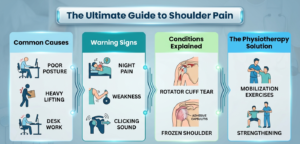
Why Your Shoulder Hurts: Understanding the Root Causes
If you are feeling a dull ache or a sharp catch in your shoulder, you aren’t alone. Shoulder pain causes are diverse, ranging from acute injuries to gradual wear and tear.
Common Physical Triggers
Muscle Strain: Overstretching the deltoids or trapezius muscles during lifting.
Tendon Inflammation (Bursitis/Tendinitis): Swelling of the fluid-filled sacs or tendons that cushion the joint.
Rotator Cuff Injuries: Micro-tears or full ruptures of the stabilizing muscles.
Frozen Shoulder: A condition where the joint capsule becomes thick and tight.
Repetitive Overhead Movement: Common in painters, swimmers, and construction workers.
The Modern Lifestyle Factor
Our daily habits are often the silent culprits behind shoulder joint pain.
The “Desk Slump”: Sitting for eight hours with rounded shoulders puts immense pressure on the front of the shoulder joint and overstretches the back muscles.

Smartphone Use: Looking down at a screen causes the head to shift forward, creating a kinetic chain reaction that imbalances the shoulder blades.
Gym Mistakes: Attempting “ego lifts”—using weights that are too heavy without proper form—is one of the leading causes of shoulder pain treatment seeking in Bangalore.
The Truth About Rotator Cuff Injuries
The term “rotator cuff” is often thrown around in sports commentary, but few people understand what it actually is until it hurts.
What Is the Rotator Cuff?
The rotator cuff is a group of four main muscles and their tendons: the supraspinatus, infraspinatus, teres minor, and subscapularis. Think of them as the “dynamic stabilizers” of your shoulder. While your larger muscles (like your chest and lats) move your arm, the rotator cuff holds the ball of your upper arm bone firmly in the shallow shoulder socket.
Common Causes of Rotator Cuff Injuries
Rotator cuff injury symptoms often stem from two sources: Trauma or Degeneration.
Sports Injuries: Sudden movements in tennis, badminton, or swimming.
Lifting Heavy Weights Incorrectly: Specifically during overhead presses or lateral raises without stabilizing the scapula.
Sudden Falls: Landing on an outstretched hand.
Age-Related Wear: Over time, the blood supply to these tendons decreases, making them more prone to fraying.
Rotator Cuff Tear Symptoms: When to Worry
How do you know if it’s a tear versus a simple strain? Look for these signs:
Shoulder Weakness: Finding it difficult to lift a bag of groceries or even a cup of coffee.
Pain at Night: A deep, throbbing ache that makes it impossible to sleep on the affected side.
Limited Movement: Pain specifically when reaching behind your back or overhead.
Clicking/Grinding: A “snapping” sensation when moving the arm in certain directions.
Frozen Shoulder Can Happen Even If You Exercise
One of the biggest myths in orthopedics is that active people are immune to frozen shoulder (Adhesive Capsulitis). In reality, we often treat athletes and fitness enthusiasts for this very condition.
Why Does It Happen?
Frozen shoulder occurs when the strong connective tissue (the shoulder capsule) surrounding the joint thickens and tightens. While the exact cause isn’t always clear, certain factors increase the risk:
Diabetes: High blood sugar can affect collagen fibers in the joint.
Post-Injury Immobility: If you stop moving your arm after a minor injury to “protect” it, the capsule can start to tighten.
Hormonal Imbalances: More common in women over 40.
The Three Stages of Frozen Shoulder
Understanding where you are in the cycle is crucial for frozen shoulder treatment.
The Freezing Stage: Pain increases gradually, and you begin to lose range of motion. This can last 6 to 9 months.
The Frozen Stage: The pain may actually decrease, but the shoulder becomes incredibly stiff. Activities like putting on a shirt become nearly impossible.
The Thawing Stage: The shoulder’s range of motion slowly begins to improve.

Are You Strengthening Your Shoulder the Wrong Way?
Many people attempt “shoulder pain treatment” at home by hitting the gym harder. Unfortunately, shoulder strengthening mistakes often lead to more harm than good.
1. Lifting Heavy Too Early
If your rotator cuff is inflamed, doing heavy shoulder presses will only “pinch” the inflamed tissue further. This is known as impingement.
2. Ignoring Mobility and Warm-ups
Strength without mobility is a recipe for injury. If your mid-back (thoracic spine) is stiff, your shoulder has to overcompensate, leading to instability.
3. Poor Scapular Control
The shoulder blade (scapula) is the foundation of the shoulder. If you don’t learn how to “set” your shoulder blades back and down, your shoulder joint remains “floating” and vulnerable during exercises.
4. Incorrect Technique
Flaring your elbows out too wide during push-ups or bench presses creates excessive “shear” force on the front of the joint.
Stop Ignoring This Shoulder Warning Sign
The body is excellent at communicating, but we are often bad at listening. Persistent shoulder pain is not a “normal part of aging.”
Red Flags You Should Never Ignore:
The “Invisible Wall”: You reach up for something, and your arm simply stops, accompanied by sharp pain.
Muscle Wasting: You notice the muscles around your shoulder blade look smaller or “dented” compared to the other side.
Numbness or Tingling: This may indicate that the shoulder issue is actually a pinched nerve in the neck.
Inability to Sleep: If pain wakes you up every time you roll over, the inflammation has reached a chronic stage.
Early physiotherapy for shoulder pain can be the difference between a 4-week recovery and a 6-month struggle.
How Physiotherapy Helps Shoulder Pain
At Move and Shine Clinic, our approach to shoulder rehabilitation exercises and recovery is holistic. We don’t just treat the pain; we treat the person.
Mobility Restoration: Using manual therapy and “joint gliding” techniques to loosen a tight capsule.
Strengthening Exercises: Moving beyond heavy weights to focus on the tiny stabilizer muscles of the rotator cuff.
Posture Correction: Realigning the spine and neck to take the “mechanical load” off the shoulder joints.
Functional Rehabilitation: Training your body to move correctly during the specific tasks you do at work or in sports.
Insights from the Experts
Physiotherapist at Move and Shine Clinic: “Many patients wait too long before seeking treatment for shoulder pain. They treat it with ice and rest for months, but rest alone doesn’t fix a mechanical imbalance. Early physiotherapy can significantly reduce recovery time and prevent the onset of chronic stiffness.”
Orthopedic Rehabilitation Specialist: “Rotator cuff injuries are very common among active individuals in Bangalore. The key is transition. Proper rehabilitation helps restore shoulder stability first, then we build power. Skipping the stability phase is why most people get re-injured.”
Exercises That Help Shoulder Recovery
While you should always consult a professional before starting a regimen, these are foundational shoulder mobility exercises used in many recovery plans:
The Pendulum: Lean over a table, letting your injured arm hang down. Gently swing it in small circles. This uses gravity to create space in the joint without using painful muscle contractions.
Wall Climbing: Stand facing a wall and “walk” your fingers up as high as you can go. This helps regain height in your reach.
Resistance Band Rotations: Keeping your elbow tucked into your side, pull a band outward. This specifically targets the rotator cuff.
Scapular Squeezes: Pinch your shoulder blades together as if holding a pencil between them. This fixes “winging” and improves the joint foundation.
Preventing Shoulder Injuries
The best shoulder pain treatment is prevention.
Ergonomic Setup: Ensure your computer monitor is at eye level so you aren’t leaning forward.
Dynamic Warm-ups: Never lift weights “cold.” Spend 5 minutes doing arm circles and band pull-aparts.
Balanced Training: For every “push” exercise (like chest press), do two “pull” exercises (like rows) to keep the shoulder balanced.
Listen to the “Nag”: If a movement feels “pinchy,” stop immediately.
Why Choose Move and Shine Clinic, Bangalore?
When it comes to physiotherapy clinic Bangalore options, Move and Shine Clinic stands out as a trusted center for orthopedic wellness. Our facility combines advanced musculoskeletal care with a patient-first philosophy.
Whether you are a professional athlete dealing with a rotator cuff injury or a corporate professional struggling with shoulder stiffness treatment, we provide:
Personalized Plans: No “cookie-cutter” exercises; every plan is tailored to your anatomy.
Advanced Techniques: From dry needling to manual mobilization.
Comprehensive Care: As a premier Orthopedic and Eye Clinic, we understand how vision and posture are linked to physical health.
Frequently Asked Questions (FAQs)
How long does shoulder pain treatment usually take? Mild strains can resolve in 2-4 weeks, while chronic conditions like frozen shoulder may require 3-6 months of consistent physiotherapy.
Can I treat a rotator cuff injury without surgery? Yes! Most partial tears and inflammatory conditions respond exceptionally well to non-surgical shoulder rehabilitation exercises.
Why does my shoulder hurt more at night? When you lie down, gravity no longer pulls the humerus down, allowing it to compress inflamed tissues in the joint.
Is heat or ice better for shoulder pain? Ice is best for acute injuries (first 48 hours). Heat is better for chronic stiffness and “warming up” a frozen shoulder before exercise.
Can neck problems cause shoulder pain? Absolutely. Referred pain from the cervical spine often manifests as pain in the shoulder blade area.
What is the most common cause of shoulder pain in Bangalore? Due to the high number of desk-bound professionals, postural strain and “impingement” are the most frequent issues we see.
Should I stop exercising completely if my shoulder hurts? No, but you should modify. Total immobility can lead to a frozen shoulder. We help you find “pain-free” movements.
What are the signs of a torn rotator cuff? The hallmark sign is weakness—specifically the inability to hold your arm out to the side against resistance.
Can a physiotherapist diagnose my shoulder issue? Yes, physiotherapists are trained to perform clinical tests to identify tears, impingement, and instability.
Is physiotherapy painful? There may be some discomfort as we work on stiff tissues, but the goal is to reduce pain, not increase it.
How do I know if it’s frozen shoulder or just a stiff muscle? Frozen shoulder involves a loss of passive motion (someone else can’t move your arm either), whereas muscle stiffness usually allows for some movement.
Does Move and Shine Clinic offer sports-specific rehab? Yes, we specialize in helping athletes return to their specific sports, from swimming to cricket.
Are there injections for shoulder pain? While we focus on physiotherapy, we coordinate with orthopedic specialists if corticosteroid or PRP injections are necessary.
Can stress cause shoulder pain? Yes, stress leads to “shrugging” the shoulders unconsciously, which causes chronic tension in the trapezius muscles.
How do I book a consultation at Move and Shine Clinic? You can visit our website at https://moveandshine.in or call our Bangalore clinic directly.
Conclusion: Take the First Step Toward Shining Again
Shoulder pain is a complex issue, but it doesn’t have to be a permanent part of your life. Whether you are dealing with the “thawing” of a frozen shoulder or recovering from a rotator cuff tear, the path to recovery is built on education, professional guidance, and patience.
Ignoring the warning signs only gives the injury time to settle in. By choosing evidence-based physiotherapy for shoulder pain and correcting your exercise techniques, you can regain your mobility and return to the activities you love.
Are you ready to move without pain? Consult the specialists at Move and Shine Clinic, Bangalore. Let us help you restore your strength and get back to your best self.