In the rapidly evolving landscape of 2026, India stands at a unique crossroads of technological prowess and public health challenges. From the silicon corridors of Bengaluru to the bustling educational hubs of Delhi and the coaching centers of Kota, the “Screen-Saturated Life” is no longer a choice—it is a requirement. However, this digital leap has brought with it a silent crisis: Digital Eye Strain (DES), also known as Computer Vision Syndrome.
As digital content strategists working alongside leading ophthalmologists, we have seen a dramatic shift. Eye care is no longer just about getting a pair of glasses; it is about managing a biological system that is being pushed to its limits by 14-hour workdays, high-intensity sports, and chronic metabolic conditions like diabetes. This definitive guide is designed for the modern Indian professional, the elite athlete, and the health-conscious senior.
The Anatomy of the Digital Struggle: Why Our Eyes Are Aching
To solve a problem, we must first understand its mechanics. The human eye evolved for survival—scanning the horizon for movement and shifting focus between distant objects. It was never designed to stare at a glowing, pixelated rectangle 18 inches away for 10 hours a day.
The Accommodation Reflex & Ciliary Muscle Fatigue
When you look at something close, the ciliary muscles inside your eye contract to change the shape of the lens. This is called “accommodation.” In a screen-saturated life, these muscles are in a state of constant contraction. Imagine holding a 5kg dumbbell at a 90-degree angle without letting go. Eventually, the muscle spasms. This leads to “Pseudo-Myopia”—a condition where your eyes are so locked into a near-focus state that distant objects appear blurry even if you don’t have true nearsightedness.
The Blinking Paradox and Tear Film Breakup
On average, we blink 15–20 times per minute. When focusing on a digital screen, our blink rate drops by nearly 70%. Blinking is the eye’s way of refreshing the tear film—a complex three-layer sandwich of oil, water, and mucus that protects the cornea. Without regular blinking, the “water” layer evaporates, leaving the eye surface exposed, red, and feeling “gritty,” like there’s sand under the eyelids.
Industry-Specific Fixes: Tailored for India’s Workforce
For the IT Professional: The “Command Center” Ergonomics
In India’s massive tech sector, eye fatigue is the leading cause of reduced coding accuracy and late-afternoon burnout.
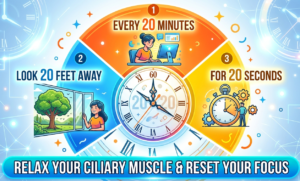
The 20-20-20 Rule: Every 20 minutes, look at an object 20 feet away for at least 20 seconds. This “breaks” the ciliary muscle contraction.
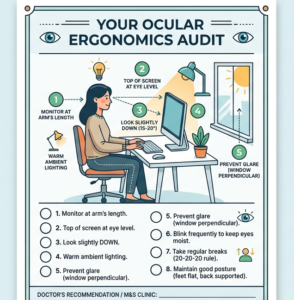
The Harmonic Distance: Your monitor should be exactly an arm’s length away. If you can’t read the text at that distance, increase the font size rather than moving closer.
Monitor Height: The top of your screen should be at eye level. This ensures you are looking slightly downward, which allows the upper eyelid to cover more of the eye, reducing tear evaporation.
For Students: Protecting the Next Generation
With the rise of ed-tech and online coaching, Indian children are developing myopia at record rates.
The “Two-Hour” Rule: For every hour of digital learning, a child needs 20 minutes of outdoor play. Natural sunlight triggers dopamine in the retina, which physically prevents the eyeball from elongating (the cause of myopia).
Tablet Distance: Ensure tablets are kept at least 12–15 inches from the face. The closer the device, the higher the strain.
For Teachers: Managing the Hybrid Classroom
Teachers today juggle physical blackboards and digital smartboards, forcing the eye to constantly “re-focus.”
Glare Control: Ensure windows are to the side of the screen, not behind it or in front of it. Use matte screen protectors to diffuse harsh classroom lighting.
Digital Hygiene: During breaks, teachers should practice “Palming”—rubbing hands together to create warmth and gently placing them over closed eyes for 60 seconds.
Beyond the Screen: Specialized Ocular Needs
The Athlete’s Edge: Sports Vision Performance
Vision is the most undervalued tool in an athlete’s kit. Whether you are a cricketer tracking a 140kmph delivery or a badminton player at a local academy, your eyes dictate your reaction time.
Contrast Sensitivity: The ability to distinguish an object from its background (e.g., a red ball against a green field). This can be trained.
Peripheral Awareness: High-intensity sports require “soft focus,” where you perceive movement in the corners of your vision without turning your head.
UV Protection: Chronic exposure to Indian sunlight during long training sessions can cause Pterygium (fleshy growth on the eye) and early cataracts. Specialized wraparound polarized lenses are mandatory for outdoor athletes.
The Diabetic Eye: A National Priority
India is the “Diabetes Capital of the World,” and Diabetic Retinopathy is a leading cause of preventable blindness.
The Leakage Problem: High blood sugar weakens the walls of retinal capillaries. They begin to leak fluid or blood, leading to “floaters” or sudden vision loss.
The Preventive Mantra: If you are diabetic, an eye exam isn’t about checking your power; it is about a “Dilated Fundus Exam” to see the health of your blood vessels.
M & S Case Studies: Real Stories, Real Solutions
To understand the impact of specialized testing, we look at three anonymized cases from our recent clinical records.
Case A: The “Burned Out” Coder (Pseudo-Myopia)
Patient: 28-year-old Senior Developer in Bengaluru. Symptoms: Constant headaches and “blurred distance vision” by 4 PM every day. Standard Test: Showed a need for -1.50 glasses. M & S Specialized Testing: We performed a Cycloplegic Refraction (relaxing the eye muscles with drops). The results revealed the patient actually had zero power—his eyes were simply in a state of permanent muscle spasm from 12 hours of coding. The Fix: Workspace audit, 20-20-20 enforcement, and “stress-relieving” computer lenses. His headaches vanished within 10 days without needing permanent distance glasses.
Case B: The State-Level Badminton Player (Visual Latency)
Patient: 19-year-old athlete. Symptoms: Struggling with fast smashes despite perfect 20/20 vision. M & S Specialized Testing: We used Saccadic Tracking Analysis. We found his “hand-eye latency” (the time it takes for the brain to process the ball’s movement and signal the hand) was 0.15 seconds slower than the elite average. The Fix: 6 weeks of Vision Therapy involving strobe glasses and tracking drills. His performance improved significantly as his brain learned to “overclock” its visual processing.
Case C: The Senior Citizen (The Silent Thief)
Patient: 68-year-old retired teacher with Type 2 Diabetes. Symptoms: None. She felt her vision was “fine for her age.” M & S Specialized Testing: We performed a High-Definition OCT (Optical Coherence Tomography) scan. The Discovery: We found microscopic “micro-aneurysms” and early-stage macular edema (swelling) that a standard torch-light exam would have missed. The Fix: Early laser intervention and strict HbA1c management. We saved her central vision before she even realized it was at risk.
The M & S Precision Diagnostic Suite
At M & S, we believe a “one size fits all” eye test is a relic of the past. We offer three specialized tiers of testing:
1. High-Performance Sports Vision Profile
Dynamic Visual Acuity: Testing how well you see while you or the object is moving.
Contrast Sensitivity Mapping: Crucial for playing under stadium floodlights.
Depth Perception Testing: Essential for sports like tennis and cricket.
2. Retinal Integrity Screening (For Diabetics & Seniors)
Digital Fundus Photography: Creating a high-resolution map of your retina.
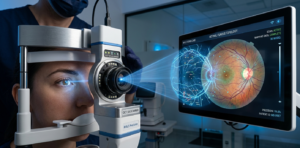
OCT (Optical Coherence Tomography): A 3D cross-section of the retina, allowing us to see beneath the surface.
Applanation Tonometry: The gold standard for measuring eye pressure to detect Glaucoma early.
The 2026 Workspace Audit Checklist
Use this checklist to ensure your home or office setup is protecting your vision.
Screen Distance: Is your monitor 20–28 inches away?
Screen Height: Is the top of the monitor at or slightly below eye level?
Lighting: Is your desk lamp positioned to avoid reflecting off the screen?
Contrast: Is your screen brightness roughly the same as the room’s ambient light?
Font Size: Can you read comfortably without leaning forward?
Chair: Does your chair allow you to sit upright with your feet flat, preventing “tech neck”?
Window Position: Are you sitting at a right angle to windows (to avoid glare/backlighting)?
Frequently Asked Questions (FAQs)
What is the “20-20-20” rule?
Every 20 minutes, look 20 feet away for 20 seconds to relax eye muscles.Does blue light cause blindness?
No, but it disrupts sleep and contributes to digital eye strain.Are “Blue Cut” lenses necessary?
They help with contrast and sleep, but they are not a substitute for taking breaks.Why do my eyes water when I’m on my laptop?
Dryness causes “reflex tearing”—your eye overreacts to being dry by producing poor-quality tears.Can I “cure” my eye power with exercises?
No, but you can reduce “pseudo-myopia” and strain through vision therapy.How often should a diabetic get an eye test?
At least once a year, even if vision feels perfect.What is an OCT scan?
It is a non-invasive imaging test that uses light waves to take a 3D picture of your retina.Can children wear contact lenses for sports?
Yes, daily disposables are often safer and provide better peripheral vision than glasses for active kids.What is Glaucoma?
It is damage to the optic nerve, often caused by high pressure. It is the “Silent Thief of Sight” because it has no early symptoms.Why do I see “halos” around lights at night?
This can be a sign of cataracts or high eye pressure. Consult a doctor immediately.Is “Dark Mode” better for my eyes?
It reduces overall brightness, which is good in dark rooms, but can cause “halation” (blurring) for some users.What is the best food for eyes?
Foods rich in Lutein and Zeaxanthin (spinach, kale), Omega-3 (fish, walnuts), and Vitamin A.Can smoking cause blindness?
Yes, smoking significantly increases the risk of Age-Related Macular Degeneration (AMD).What is a “Blinking Drill”?
Close your eyes, count to two, squeeze slightly, and open. Repeat 10 times to “reset” your tear film.Does screen glare cause headaches?
Yes, it forces the eye to work harder to distinguish text from the background.What are “Floaters”?
Tiny spots in your vision. A sudden increase can indicate a retinal tear—a medical emergency.Is it okay to use OTC “redness relief” drops?
Avoid them. They constrict blood vessels and can cause “rebound redness.” Use preservative-free artificial tears instead.Can sports vision training improve my reaction time?
Yes, by training the brain to process visual information faster.What is Macular Edema?
Swelling in the central part of the retina, often caused by diabetes.Can I use my smartphone in bed?
It is highly discouraged. The high contrast and proximity in the dark cause extreme ocular stress.
Doctor’s Comment: The Path Forward “We are witnessing a shift from ‘Optical Care’ (fixing vision) to ‘Ocular Health’ (preventing disease). In a country like India, where we have the highest burden of both diabetes and digital usage, a standard eye test is no longer enough. Precision diagnostics like those we use at M & S—especially for athletes and diabetics—are the only way to ensure that our ‘Screen-Saturated Lives’ don’t lead to a lifetime of darkness.” — M & S Vision Care