
Your shoulder has been stiff for months. Raising your arm to brush your hair feels impossible. Sleeping through the night is a distant memory. Your doctor has mentioned a corticosteroid injections for frozen shoulder — and you are not sure whether to agree.
You are not alone. Frozen shoulder, medically called adhesive capsulitis, affects up to 5% of adults — most commonly women between 40 and 60 years of age, and people living with diabetes or thyroid conditions [1]. Corticosteroid (steroid) injections are one of the most commonly recommended interventions, yet most patients receive very little information about what the injection actually does, how long the effect lasts, what the risks are, and — critically — what needs to happen after the injection to make it worthwhile.
This guide gives you everything you need to make an informed decision: the science, the benefits, the real risks, what to expect on the day, and why the injection alone is rarely enough.
What Is a Corticosteroid Injection — and What Does It Actually Do?
Corticosteroids are synthetic versions of cortisol, the hormone your body naturally produces in response to inflammation. When injected directly into the shoulder joint — most accurately done under ultrasound guidance — they deliver a concentrated anti-inflammatory effect to the exact site of the problem.
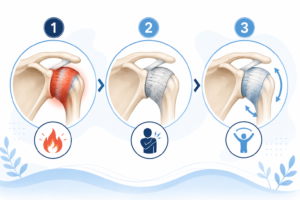
In frozen shoulder, the joint capsule becomes inflamed, thickened, and progressively scarred. This is what causes the characteristic stiffness that develops in three stages:
- Freezing (Stage 1 — 6 weeks to 9 months):Severe pain, gradual loss of movement, often worst at night
- Frozen (Stage 2 — 4 to 12 months):Pain begins to ease slightly but movement is severely restricted
- Thawing (Stage 3 — 5 to 26 months):Gradual spontaneous return of movement
Corticosteroid injections are most effective in Stage 1 (the freezing stage) when inflammation is at its highest. The injection does not break down scar tissue or stretch the capsule — that is the role of physiotherapy. What it does is reduce the inflammatory component, which in turn reduces pain and can make physiotherapy exercises more achievable.
“A corticosteroid injection is a window of opportunity — it reduces pain enough to let the physiotherapy work. Without the follow-up rehabilitation, the window closes without lasting benefit.” — Dr. Viresh, Orthopedic Consultant, Move and Shine |
The Benefits: What the Evidence Actually Shows
Multiple clinical trials and systematic reviews have examined corticosteroid injections for frozen shoulder. The honest summary from the evidence:
Short-term pain relief is well-supported
A 2017 Cochrane Review found that corticosteroid injections provided significant short-term benefit — improved pain and function at 6 weeks compared to physiotherapy alone or placebo [2]. Patients typically notice the injection working within 3 to 10 days, with peak effect at around 3 to 4 weeks.
The effect fades over 3 to 6 months
This is where most patients are not fully informed. The improvement from a steroid injection is not permanent. Studies consistently show the benefit diminishes at the 3-month mark and is largely absent by 6 months without accompanying physiotherapy. The injection buys time — it does not cure.
Earlier intervention produces better results
Injections given in Stage 1 produce meaningfully better outcomes than those given in the frozen or thawing stages. If a steroid injection is being considered, earlier is better.
Combined with physiotherapy, results are significantly better
The evidence strongly supports using corticosteroid injection as the first step in a combined protocol — injection followed immediately by structured physiotherapy — rather than as a standalone treatment [3].
Outcome Measure | Injection Only | Injection + Physiotherapy |
Pain at 6 weeks | Significant improvement | Significant improvement |
Range of motion at 3 months | Moderate | Significantly better |
Sustained benefit at 6 months | Fades | Maintained |
Return to daily activities | Partial | Full in most cases |
The Risks and Side Effects: What You Must Be Aware Of
Corticosteroid injections are generally safe when administered correctly. However, they carry real risks that should be part of any honest conversation with your doctor.
Common side effects (typically mild and short-lived)
- Post-injection flare:Up to 10–15% of patients experience a temporary increase in pain for 24–48 hours after the injection. This is caused by crystal-induced synovitis — the crystalline corticosteroid formulation irritating the joint lining. It resolves on its own; ice and paracetamol help manage it.
- Skin changes at the injection site:A small pale patch (skin depigmentation) or slight depression of the skin can occur, more commonly in darker skin tones. This is cosmetically noticeable but medically benign.
- Facial flushing:Some patients, particularly women, experience temporary flushing or feeling of warmth in the face for 1–2 days after the injection. This is a systemic response to the corticosteroid.
- Temporary blood sugar elevation:Critically important for diabetic patients. Corticosteroids can raise blood glucose levels for 3–5 days after injection. Patients with diabetes must monitor their blood sugar closely and inform their endocrinologist or GP before proceeding.
Serious risks (less common, but important to understand)
- Tendon weakening:Repeated corticosteroid injections into or near tendons can weaken tendon tissue. This is why most guidelines recommend no more than 3 injections into the same joint, and a minimum interval of 3 months between injections.
- Joint infection (septic arthritis):Rare — estimated at 1 in 15,000 to 1 in 50,000 injections — but a serious complication requiring urgent medical treatment. Signs: rapidly worsening pain, redness, warmth, and fever within days of injection. Seek emergency care immediately if these develop.
- Cartilage damage with repeated injections:Multiple corticosteroid injections over a short period have been associated with accelerated cartilage breakdown in some studies. This is one of the strongest arguments against over-reliance on injections.
- Avascular necrosis (very rare):Extremely rare with shoulder injections, but repeated high-dose corticosteroids have been linked to avascular necrosis (bone death) in major joints.
⚠️ Who should use caution or avoid steroid injections? • People with uncontrolled diabetes (blood sugar management required first) • Those on blood-thinning medication (warfarin, rivaroxaban, aspirin — discuss with your GP) • Active joint infection — injection is absolutely contraindicated • Recent vaccination — ideally wait 2 weeks • Allergy to corticosteroid formulations (rare but possible) • Pregnancy — discuss risk-benefit with your obstetrician |
How Many Injections Can You Have? And How Often?
Most clinical guidelines and orthopaedic practitioners follow these principles:
- Maximum 3 injections per jointover the course of the condition
- Minimum 3 months between injectionsto allow the previous injection to take full effect and reduce the risk of tissue damage
- Reassessment before each repeat injection— if the first injection produced no benefit, a second is unlikely to help; a change in treatment strategy is warranted
The diminishing returns principle applies: the first injection in Stage 1 typically produces the best result. A second injection may still help if the first gave partial benefit. A third injection is generally only considered if there has been a clinically meaningful but incomplete response, and the patient is not yet a candidate for hydrodilatation or other procedures.
Do not accept ongoing repeat injections without a clear reassessment and discussion of alternative treatment pathways.
What to Expect: Before, During, and After the Injection
Before the injection
- Arrange for someone to drive you home — your shoulder may be temporarily weak or uncomfortable
- Inform your doctor of all medications, particularly blood thinners, diabetes medications, and any supplements including fish oil (mild blood-thinning effect)
- If you have diabetes, check your blood sugar before attending and plan for elevated readings for the next 3–5 days
- Ask whether the injection will be image-guided (ultrasound). Image-guided injections are significantly more accurate — studies show freehand shoulder injections miss the joint capsule in up to 30% of cases [3]
During the injection
The procedure typically takes 5–10 minutes. A local anaesthetic is usually mixed with the corticosteroid. You may feel pressure, a brief stinging sensation as the needle is inserted, and possibly a feeling of fullness in the joint as the fluid is delivered. It is not pain-free, but it is well-tolerated by most patients.

After the injection — the first 48 hours
- Rest the shoulder for the remainder of the day
- Apply ice (wrapped in cloth) for 10–15 minutes if a post-injection flare occurs — do not apply heat
- Paracetamol is appropriate for pain management; avoid anti-inflammatories (ibuprofen, naproxen) for the first 48 hours as they can partially counteract the corticosteroid
- Do not swim, use a hot tub, or submerge the injection site for 48 hours
- Monitor for signs of infection: increasing pain, swelling, warmth, redness, or fever — if these develop, seek urgent medical care
After the injection — the critical window (Week 1–6)
This is the most important phase that most patients are not told about. The injection reduces inflammation and pain — but it does not restore movement. If you do not begin physiotherapy during this window when pain is reduced, the inflammation will return and the capsule will continue to contract.
The injection is not the treatment. The physiotherapy that follows is the treatment. The injection creates the conditions that make physiotherapy possible. |
Why Physiotherapy After the Injection Is Not Optional
The joint capsule in frozen shoulder does not spontaneously open because inflammation has reduced. The adhesions and fibrotic tissue that have formed require mechanical stretching to break down. Physiotherapy provides this through:
- Capsular stretching exercises— cross-body stretch, sleeper stretch, and towel stretch target specific areas of the contracted capsule
- Pendulum exercises— gravity-assisted, gentle capsular decompression even in the pain-dominant stage
- Progressive range-of-motion work— wall walks and overhead exercises to restore full arc of movement
- Strengthening— once range is recovering, the rotator cuff and scapular stabilisers need to be retrained to prevent recurrence
Physiotherapy should begin within 1–2 weeks of the injection — once the immediate post-injection discomfort has settled and the anti-inflammatory effect is building. Earlier re-engagement with movement leads to meaningfully better outcomes.
If your doctor has given you the injection but has not discussed physiotherapy, ask for a referral. The two must go together.
Corticosteroid Injection vs. Other Frozen Shoulder Treatments
A corticosteroid injection is not the only option, and for many patients it is not the right first step. Here is an honest comparison:
Treatment | Best Stage | What It Does | Main Limitation |
Physiotherapy alone | All stages | Stretches capsule, restores movement | Difficult in Stage 1 pain |
Corticosteroid injection + physio | Stage 1 (best) | Reduces inflammation, enables physio | Temporary; risks with repetition |
Hydrodilatation | All stages, esp. Stage 1-2 | Stretches capsule from inside | Requires imaging; not widely available |
Manipulation under anaesthesia | Stage 2-3 not responding | Breaks adhesions physically | Post-procedure rehab essential |
Surgery (arthroscopic release) | Refractory cases only | Removes scar tissue directly | Invasive; last resort |
For most patients in Stage 1 with significant pain, the corticosteroid injection + immediate physiotherapy combination is the first-line recommended approach. For patients who have already progressed into Stage 2 with severe stiffness but lower pain, hydrodilatation may be a more appropriate intervention.
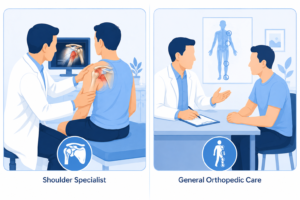
Why It Matters Who Performs the Injection: Shoulder Surgeon vs. General Orthopedic Surgeon”
Not all orthopedic surgeons are trained to the same depth in shoulder-specific conditions. A shoulder surgeon — an orthopedic specialist with focused fellowship training in shoulder pathology — has significantly more experience diagnosing the exact stage of frozen shoulder, distinguishing it from rotator cuff tears or impingement, and administering injections with greater precision, particularly under ultrasound guidance. A regular orthopedic surgeon may treat shoulders only occasionally as part of a broader general practice covering hips, knees, and spine. For frozen shoulder specifically, this distinction matters because the injection technique, the choice of corticosteroid formulation, and — most importantly — the physiotherapy program that follows need to be tailored to the patient’s exact stage and presentation. A shoulder surgeon is more likely to coordinate the injection and the rehabilitation plan as one connected protocol, rather than treating the injection as a standalone procedure. If you’re searching for a shoulder surgeon near me, it’s worth checking specifically for shoulder-fellowship training rather than assuming any orthopedic surgeon is equally equipped — and if you’re trying to find the best shoulder surgeon in Bangalore, look for someone who routinely treats frozen shoulder cases and offers a clear, combined injection-plus-physiotherapy plan rather than an injection alone.
Questions to Ask Your Doctor Before Agreeing to the Injection
You are entitled to a full explanation before any procedure. Use this list:
- Is this injection being done under ultrasound guidance?
- Which corticosteroid formulation are you using, and why?
- What improvement should I realistically expect, and by when?
- Will I be referred for physiotherapy immediately after — and when should I start?
- I have diabetes / am on blood thinners — how does that change the plan?
- If this injection does not help, what is the next step?
- How many injections are you planning, and what is the interval?
- What are the signs of infection I should watch for after the procedure?
Realistic Recovery Timeline with Corticosteroid Injection + Physiotherapy
Timeframe | What to Expect | What You Should Be Doing |
Days 1–3 | Possible post-injection flare; ice and rest | Rest, ice, paracetamol if needed |
Days 4–10 | Anti-inflammatory effect building; pain reducing | Gentle pendulum exercises, begin physio |
Weeks 2–6 | Pain window open; most benefit from physio here | Active physio: capsular stretches, wall walks |
Months 2–3 | Steroid effect fading; movement gains should continue | Continue physio; strengthening begins |
Months 3–6 | Most patients see sustained improvement | Home exercise programme; maintain gains |
6–18 months | Full recovery in most Stage 1-2 patients | Ongoing strengthening; prevent recurrence |
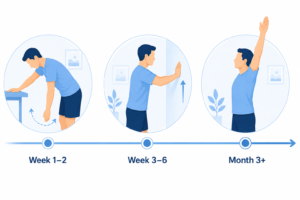
Early physiotherapy is the single strongest predictor of faster recovery. Patients who begin structured rehabilitation within 2 weeks of injection consistently achieve full range of movement 3–6 months sooner than those who wait.