
Medically Reviewed by Dr. Dona Susan John, Eye Care Specialist, Move & Shine Orthopedic Wellness & Eye Clinic, Bangalore Last Updated: October 2026
Glaucoma vs cataracts in seniors is one of the most important comparisons in eye health, because the two conditions can feel alike (“my vision is not what it used to be”) yet behave very differently. A cataract clouds the lens and can be fully corrected with surgery. Glaucoma damages the optic nerve, usually without any symptoms, and the sight it takes cannot be brought back. In India, where about two-thirds of blindness is caused by cataract and roughly 90% of glaucoma is believed to go undiagnosed, knowing the difference can genuinely protect your sight. This guide explains the early warning signs, the key differences, and practical steps for vision preservation, and shows how to find an eye specialist near you in Bangalore.
Quick answer: Cataracts cause gradual cloudy or blurry vision, glare and faded colours, and are reversed with surgery. Glaucoma usually causes no early symptoms, slowly steals side (peripheral) vision, and its damage is permanent, though treatment can stop it from getting worse. Only an eye examination can tell them apart. Seniors should be examined at least every 1 to 2 years, and yearly if they have diabetes, a family history of glaucoma or other risk factors. Sudden eye pain with a red eye, halos and vomiting is an emergency.
Key Takeaways
- Cataract is a clouding of the lens. It is gradual, usually painless and treatable with surgery.
- Glaucoma is damage to the optic nerve. It is usually silent, and lost vision cannot be restored.
- You cannot reliably tell them apart yourself, and you can have both at once.
- Early detection through regular eye examinations matters far more for glaucoma than waiting for symptoms.
- Eye health and fall prevention go together: poor vision raises the risk of falls and fractures in older adults.
Glaucoma vs Cataracts in Seniors: What Is the Difference?
What Is a Cataract?
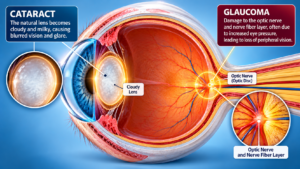
The lens inside your eye sits behind the pupil and focuses light onto the retina. With age it gradually turns cloudy, so light is scattered rather than focused. The result is blurred, hazy or dimmed vision. Cataracts develop slowly, are usually painless, and are the most common cause of treatable vision loss in older adults. For a detailed look at the operation itself, see our guide to cataract surgery in Bangalore: procedure, recovery and what to expect.
What Is Glaucoma?
Glaucoma is a group of conditions that damage the optic nerve, the cable that carries images from the eye to the brain. The damage is most often linked to eye pressure that is too high for that particular nerve to tolerate, although some people develop it at normal pressures. According to the American Academy of Ophthalmology (AAO), open-angle glaucoma, the most common type, has no warning signs or obvious symptoms in its early stages, and any vision loss that has already occurred cannot be reversed. Treatment can only stop further damage.
Key Differences at a Glance
Cataract | Glaucoma | |
What happens | The natural lens becomes cloudy | The optic nerve is gradually damaged, often linked to eye pressure |
Onset | Gradual | Usually slow and silent; sudden in acute angle-closure |
What you notice first | Blurry or cloudy vision, glare, faded colours | Often nothing; later, patchy loss of side vision |
Pain | Usually painless | Usually painless; severe in an acute attack |
Is the vision loss reversible? | Yes, with surgery | No. Treatment prevents further loss |
Main treatment | Cataract surgery with a lens implant | Eye drops, laser or surgery to lower eye pressure |
What the doctor finds | A cloudy lens | Optic nerve changes, visual field loss, often raised or high-normal pressure |
Why This Matters for Seniors in India
The numbers explain why eye examinations in older age are so important:
- Cataract is the leading cause of blindness in India. The National Blindness and Visual Impairment Survey found it accounts for about 66% of blindness, with uncorrected refractive errors at about 19% and glaucoma at about 7%. Experts note that around 85% of vision loss in the country is preventable or treatable.
- Glaucoma affects roughly 12 million Indians, and about 1.5 million are blind from it, making it the most common cause of irreversible blindness. Published reviews estimate that around 90% of glaucoma in India is undiagnosed, compared with a much lower share in developed countries.
- In India, primary open-angle glaucoma is more common than angle-closure glaucoma, but people with angle-closure glaucoma may be about twice as likely to go blind.
In other words, cataract is the bigger problem by numbers but is fixable, while glaucoma is the quieter problem that people discover too late.
Early Warning Signs of Cataracts in Seniors
Cataract symptoms usually creep in over months or years. Watch for:
- Cloudy, blurry or “foggy” vision that glasses no longer fix
- Glare and starbursts from headlights at night, or discomfort in bright sunlight
- Halos around lights
- Colours that look faded or yellowish
- Double vision in one eye
- Needing brighter light to read
- Frequent changes in your glasses prescription
Some people with early cataracts notice a short-lived improvement in near vision, sometimes called “second sight”, before vision worsens again. It can feel like good news, but it is part of the same process.
If cloudy vision is your main complaint, remember that other things can mimic it. Dry, irritated eyes can also blur vision, particularly in people who spend long hours on screens. Our guide on dry eyes from screen use explains the difference.
Early Warning Signs of Glaucoma in Older Adults
This is where the “silent thief of sight” label comes from. In open-angle glaucoma, there are usually no symptoms in the early stages. Your brain fills in missing areas, and the healthier eye compensates for the weaker one, so you may not notice anything until the disease is advanced. When symptoms do appear, they often include:
- Slow loss of side (peripheral) vision, sometimes described as tunnel vision
- Patchy blind spots in your field of view
- Bumping into objects, missing steps or kerbs, or not seeing people approaching from the side
- Difficulty with night driving or moving in dim light
The Emergency Form: Acute Angle-Closure Glaucoma
A different form of glaucoma can strike suddenly. In acute angle-closure glaucoma, the drainage channel in the eye is abruptly blocked and pressure rises quickly. Symptoms include severe eye pain, a red eye, blurred vision, rainbow-coloured halos around lights, headache, nausea and vomiting. This is a medical emergency, and immediate treatment is needed to prevent permanent vision loss. Do not wait for it to pass. Go to an eye emergency department straight away.
“Many seniors tell me they assumed the change in their vision was just part of getting older. For cataracts, that is true, and they are fixable. Glaucoma is different. It hides, so by the time you notice it, a lot of sight is already gone. That is why an examination, not symptoms, should decide when you get checked.”
Dr. Dona Susan John, Eye Care Specialist, Move & Shine
Glaucoma vs Cataracts in Seniors: How the Symptoms Compare
This table is to help you describe your symptoms to a doctor. It cannot replace an examination.
What you are noticing | More suggestive of |
Blurry, hazy or foggy vision overall | Cataract (or dry eye, or a glasses change) |
Glare and halos around headlights at night | Cataract |
Colours look faded or yellow | Cataract |
Needing a stronger glasses prescription every few months | Cataract |
Missing things at the edges of your vision | Glaucoma |
Walking into objects or missing steps | Glaucoma |
No symptoms at all | Could be either; this is exactly why screening matters |
Sudden severe eye pain, red eye, vomiting | Acute angle-closure glaucoma: emergency |
Can You Have Glaucoma and Cataracts at the Same Time?
Yes, and it is common, because both become more frequent with age. Some points worth knowing:
- A cataract can hide the early signs of other eye problems, which is one reason a full eye examination looks at the optic nerve and retina as well as the lens.
- In some people with narrow drainage angles, removing the eye’s natural lens during cataract surgery can lower eye pressure, according to the AAO. Cleveland Clinic similarly notes that cataract removal can slow the progression of chronic angle-closure glaucoma. This does not mean cataract surgery cures glaucoma. It means the two conditions often need to be managed together.
- Long-term steroid use, whether tablets, eye drops or inhalers, can raise eye pressure and also contribute to cataract formation, so tell every doctor what medicines you take.
- Other age-related conditions such as macular degeneration and diabetic eye disease can occur alongside both. See our guides on macular degeneration warning signs and diabetic retinopathy.
Who Is at Risk? Glaucoma vs Cataract Risk Factors
Risk factor | Cataract | Glaucoma |
Older age | Yes | Yes |
Family history | Sometimes | Yes, a strong factor |
Diabetes | Yes, may appear earlier | Associated with higher risk |
Long-term steroid use | Yes | Yes (can raise eye pressure) |
Smoking | Yes | Less clear |
Strong sunlight exposure without UV protection | Yes | No clear link |
Past eye injury or inflammation | Yes | Yes |
High short-sightedness (myopia) | Yes | Yes |
Long-sightedness or narrow drainage angles | Not typically | Yes (angle-closure) |
These are general risk factors. Your doctor can assess your personal risk.
How Doctors Diagnose Glaucoma and Cataracts
A comprehensive eye examination is painless and usually takes under an hour. According to the AAO, an evaluation for glaucoma involves checking eye pressure, the drainage angle, the optic nerve, peripheral (side) vision and the thickness of the cornea. Looking at all of these together matters, because a single normal pressure reading can be falsely reassuring: some people develop glaucoma at normal pressures, and pressure can fluctuate during the day.
For cataracts, the doctor examines the lens under magnification and checks how much it affects your sight. A dilated retinal examination is also done to look for other conditions behind the lens.
One practical note: in eyes with very narrow drainage angles, dilating drops can in rare cases trigger an acute attack. This is one of the reasons the drainage angle is checked as part of a proper glaucoma evaluation, and why you should always report severe eye pain, redness or nausea after an eye examination immediately.
“A glaucoma check is not just ‘eye pressure’. We look at the optic nerve, the drainage angle and the visual field together, because a single normal reading can be falsely reassuring. If you have a family history, tell us even if your vision seems perfect.”
Dr. Dona Susan John, Eye Care Specialist, Move & Shine
Treatment: Cataracts and Glaucoma Compared
Cataract Treatment
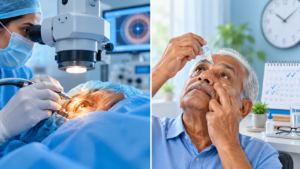
There are no eye drops that remove a cataract. When the cloudiness interferes with daily life, such as reading, cooking, recognising faces or driving, the treatment is surgery. The cloudy lens is replaced with a clear artificial lens, usually as a day-care procedure, and it is one of the most commonly performed and successful operations in medicine. Our cataract surgery guide covers lens options, recovery and what to expect. Waiting for a cataract to become “ripe” is outdated advice: surgery can be planned when vision begins to affect your daily life, and delaying too long can raise the risk of falls and, in dense cataracts, can make surgery more difficult.
Glaucoma Treatment
The goal is to lower eye pressure and stop further nerve damage. As the AAO describes, options include:
- Medicated eye drops, which are the usual first step
- Laser procedures, such as trabeculoplasty to improve drainage in open-angle glaucoma, or iridotomy to create a new channel in angle-closure glaucoma
- Operating-room surgery, such as trabeculectomy or drainage implants, when drops and laser are not enough
Glaucoma treatment is usually lifelong. The drops only work if used every day, and because the damage is silent and irreversible, missing doses is the most common and most avoidable reason for vision loss in treated patients. Some drops can cause side effects such as blurred vision, redness or dry eyes, so if you are struggling with them, tell your doctor rather than stopping. There is often another option.
“The glaucoma patients who keep their vision are not the ones with the best eyes to begin with. They are the ones who put their drops in every day and never miss a follow-up.”
Dr. Dona Susan John, Eye Care Specialist, Move & Shine
Vision Preservation: 9 Practical Steps for Seniors
- Get a comprehensive eye examination at least every 1 to 2 years, and yearly if you have diabetes, a family history of glaucoma, or other risk factors. Our article on periodic eye checks that protect vision and performance explains why routine checks matter even when your vision seems fine.
- Know your family history and share it with your siblings and children. Glaucoma runs in families.
- Take glaucoma drops exactly as prescribed. Link them to a daily routine, such as brushing teeth, set a phone reminder, or ask a family member to help.
- Do not postpone cataract surgery until you can barely see. Operate when your vision interferes with daily life, as advised by your eye specialist.
- Control diabetes and blood pressure. Both affect eye health, and diabetes can cause its own sight-threatening problems.
- Protect your eyes. Wear UV-blocking sunglasses outdoors, avoid smoking, and use steroid medicines only when prescribed and monitored.
- Keep your glasses up to date. An outdated prescription can make vision worse and mimic age-related changes. Our guide to sustainable eyewear and refractive errors covers choosing the right glasses.
- Make your home safe for low vision. Use bright, even lighting, high-contrast edges on steps, clear walkways and non-slip mats.
- Know the emergency signs. Severe eye pain, a red eye, halos, headache and vomiting need immediate care.

Vision, Falls and Fractures: Why Eye Care Is Also Bone and Joint Care
Poor vision is a recognised risk factor for falls in older adults, and falls are a leading cause of fractures. Missed steps from lost side vision, glare from an untreated cataract or an outdated prescription can all contribute. That is why caring for your eyes protects your hips, wrists and spine as well.
Pairing regular eye checks with strength, balance and mobility work is one of the best ways to stay independent. Our guide to longevity training for musculoskeletal health covers strength and balance, and our orthopedic wellness services support bone and joint health. As a combined orthopedic and eye clinic, Move & Shine can look after both under one roof.
Eye Specialist in Bangalore: Glaucoma and Cataract Care at Move & Shine
If you are searching for an eye specialist Bangalore for a glaucoma check or a cataract assessment, Move & Shine Orthopedic Wellness and Eye Clinic is located on Uttarahalli Main Road in South Bangalore. Our eye care is led by Dr. Dona Susan John, an ophthalmologist and medical retina specialist who has treated over 5,000 patients since 2017. Our eye care team evaluates cataract, glaucoma and other age-related eye conditions as part of our eye care services.
What to bring to your appointment:
- Your current glasses and any previous prescriptions or eye reports
- A list of all your medicines, especially steroids and eye drops
- Details of any family history of glaucoma, cataract or blindness
- A companion, as your vision may be blurry after dilating drops and you should not drive afterwards
To book an appointment, call +91-96320 14086.
Frequently Asked Questions

