Medically Reviewed by: Dr. Pradeep Kocheeppan — Best Knee & Shoulder Surgeon in Bangalore (20+ years of clinical experience in Joint Conservation, Arthroscopy, and Sports Medicine)
The Non-Surgical Joint Injection Dilemma
When sharp knee pain makes every step down the stairs agonizing, or persistent shoulder stiffness prevents you from sleeping on your side, immediate relief becomes your top priority. For millions of adults suffering from mild-to-moderate osteoarthritis, rotator cuff tendinopathy, or stubborn sports injuries, major surgery like joint replacement is often unnecessary.
Instead, modern non-surgical joint care offers two leading injectable therapies: Corticosteroid (Steroid) Injections and Platelet-Rich Plasma (PRP) Therapy.
Both treatments are delivered directly into the knee or shoulder joint capsule, but they function on completely opposing medical principles:
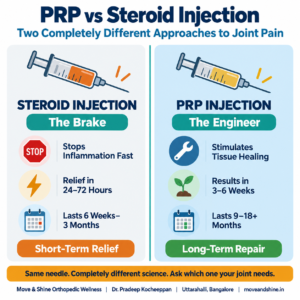
Steroid injections act as powerful biological “brakes,” rapidly shutting down severe inflammation to deliver fast, short-term pain relief.
PRP injections act as biological “engineers,” utilizing your body’s concentrated growth factors to stimulate long-term tissue repair and joint conservation.
Which option offers the safest, longest-lasting outcome for your knee or shoulder condition?
This clinical guide provides a comprehensive comparison of PRP vs. Steroid injections, evaluating cellular mechanisms, recovery timelines, side effect profiles, costs, and decision factors to help you make an informed choice alongside our specialists at Move & Shine Orthopedic Wellness & Eye Hospital in South Bangalore
2. What Is Corticosteroid Injection Therapy?
A corticosteroid injection is a synthetic formulation of cortisol—a hormone naturally produced by your adrenal glands to suppress inflammation.
Corticosteroid Injected ➡️ Suppresses Inflammatory Enzymes ➡️ Reduces Joint Swelling & Pain (Rapid 24-72 Hr Relief)
How It Works inside the Joint
When injected into an inflamed joint capsule, surrounding fluid, or tendon sheath, corticosteroids aggressively inhibit pro-inflammatory enzymes and white blood cells. This chemical reaction rapidly halts local tissue swelling, relieves fluid pressure, and numbs pain pathways.
For a deeper dive into steroid therapy protocols, review our detailed guide on Corticosteroid Injections for Frozen Shoulder: A Complete Guide.
Key Clinical Advantages
Rapid Onset: Pain relief usually takes effect within 24 to 72 hours.
High Anti-Inflammatory Potency: Highly effective at calming severe, acute inflammatory flare-ups.
Cost-Effective Initial Therapy: Widespread accessibility makes it an economical choice for immediate symptom management.
Potential Drawbacks & Risks
Temporary Effect: Pain relief typically lasts between 6 weeks and 3 months.
Cartilage and Tendon Degradation: Repeated corticosteroid injections can weaken tendon structures and accelerate cartilage thinning over time.
Steroid Flare & Glycemic Spikes: Patients may experience a temporary spike in joint pain for 24 hours post-injection, as well as temporary elevations in blood sugar levels—a key consideration for diabetic patients.
3. What Is Platelet-Rich Plasma (PRP) Therapy?
Platelet-Rich Plasma (PRP) is an advanced regenerative treatment that harnesses the healing potential of your own blood to repair damaged joint tissues.
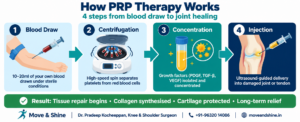
Autologous Blood Draw ➡️ Centrifugation (Separates Platelets) ➡️ Concentrated Growth Factors Injected ➡️ Tissue Repair & Cartilage Protection
How It Works inside the Joint
During a PRP procedure, a small sample of your blood is drawn and spun in a high-speed centrifuge. This process separates concentrated blood platelets—which contain rich stores of bioactive growth factors (such as PDGF, TGF-beta, and VEGF)—from red blood cells.
When concentrated PRP is precise-injected into a damaged knee cartilage zone or torn shoulder rotator cuff, these growth factors activate local cellular repair, stimulate collagen production, and reduce chronic cellular inflammation.
Explore our comprehensive patient resource on Orthopedic Home Care for Bone and Joint Diseases to see how regenerative procedures integrate with holistic recovery.
Key Clinical Advantages
Biological Joint Conservation: Uses 100% autologous (your own) blood products, virtually eliminating the risk of allergic reactions or tissue rejection.
Long-Term Sustained Relief: Clinical improvement typically lasts 9 to 18 months or longer.
Promotes Tissue Health: Protects remaining cartilage structures and strengthens surrounding ligaments rather than breaking them down.
Potential Drawbacks
Delayed Relief: Healing is a progressive process; initial improvements usually appear after 3 to 6 weeks.
Multiple Sessions Required: Optimal joint recovery often requires a series of 2 to 3 sessions spaced several weeks apart.
Higher Initial Cost: Advanced processing technology makes initial treatment costs higher than standard steroid shots.
4. Head-to-Head Comparison: PRP vs. Steroid Injections
To weigh these options clearly, compare how PRP and Corticosteroid injections perform across key medical and practical criteria:
+---------------------------------------------------------------------------------------------------+
|                                  PRP vs STEROID INJECTION COMPARISON                              |
+-------------------+---------------------------------------+---------------------------------------+
| Feature           | Corticosteroid Injections             | Platelet-Rich Plasma (PRP)            |
+-------------------+---------------------------------------+---------------------------------------+
| Primary Objective | Rapid symptom and pain suppression    | Long-term tissue repair & conservation|
| Mechanism         | Synthetic hormone chemical block      | Concentrated autologous growth factors|
| Onset of Relief   | 24 to 72 hours                        | 3 to 6 weeks (progressive healing)    |
| Duration of Relief| 6 weeks to 3 months                   | 9 to 18+ months                       |
| Effect on Tissue  | May weaken collagen with repeated use | Preserves cartilage & strengthens tissue|
| Repeat Frequency  | Max 2–3 times per year per joint      | Safe to repeat as clinically needed   |
| Diabetic Safety   | May cause temporary blood sugar spikes| 100% safe (no glycemic interference)  |
+-------------------+---------------------------------------+---------------------------------------+
5. Knee Applications: Osteoarthritis, Meniscus & Ligaments
Knee pain is one of the most frequent complaints evaluated by Dr. Pradeep Kocheeppan — Best Knee & Shoulder Surgeon in Bangalore at Move & Shine[cite: 1, 2]. Determining the right injection depends heavily on your specific diagnosis.
                              KNEE PAIN DIAGNOSIS
                                       │
            ┌──────────────────────────┴──────────────────────────┐
            ▼                                                     ▼
Acute Arthritis Flare / Severe Hydrops                 Early-to-Moderate OA / Tendinopathy
(Needs Instant Relief for Event)                     (Needs Long-Term Joint Conservation)
            │                                                     │
            ▼                                                     ▼
   CORTICOSTEROID INJECTION                                   PRP THERAPY
Mild-to-Moderate Knee Osteoarthritis (Grade 1–3)
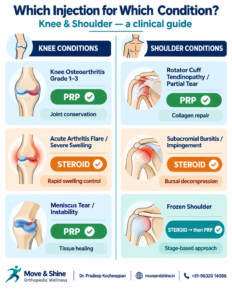
The Clinical Choice: PRP Therapy is superior for early-to-moderate knee OA. Clinical studies demonstrate that PRP improves joint lubrication, slows down cartilage breakdown, and enhances knee function longer than steroids.
Related Guide: Learn more about surgical vs. conservative pathways in our article: Will Every Knee Pain or Arthritis Patient Need Knee Replacement Surgery?.
Acute Knee Arthritis Flare-ups (Severe Swelling)
The Clinical Choice: Corticosteroid Injection. When a knee is acutely swollen, warm, and filled with fluid (joint effusion), a steroid shot rapidly calms the flare-up so physical therapy can begin.
Meniscus Tears and Knee Instability
The Clinical Choice: PRP Therapy. PRP delivered directly to vascular meniscus zones promotes tissue healing and supports joint stability. For persistent mechanical issues, consult our guide on Why Does Your Knee Feel Unstable Even When It Doesn’t Hurt?.
6. Shoulder Applications: Rotator Cuff, Bursitis & Frozen Shoulder
The shoulder is an intricate ball-and-socket joint that relies heavily on healthy soft tissues. Selecting the correct injection type depends on whether the primary problem is inflammation or structural degeneration.
Rotator Cuff Tendinopathy & Partial Tears
The Clinical Choice: PRP Therapy. Steroid injections placed directly around tendons can weaken collagen fibers, increasing the long-term risk of a full-thickness rotator cuff tear. PRP stimulates healthy collagen synthesis, aiding tendon repair.
Learn More: Review Shoulder Pain Causes and Treatment: Complete Orthopedic Guide for diagnostic insights.
Subacromial Bursitis & Impingement
The Clinical Choice: Corticosteroid Injection. When severe bursal swelling causes acute arm impingement, a targeted steroid shot reduces bursal volume quickly, unlocking shoulder motion.
Adhesive Capsulitis (Frozen Shoulder)
The Clinical Choice: Combined Approach. An initial steroid shot is often utilized during the acute “freezing” phase to manage intense night pain. Once severe inflammation cools, PRP paired with physical therapy helps restore capsule elasticity.
7. The Role of Physiotherapy in Injectable Treatments
Neither PRP nor steroid injections should serve as standalone treatments. Injectable therapies create a critical “window of opportunity” by reducing pain and inflammation, allowing you to engage effectively in Physiotherapy and Exercise Training .
At Move & Shine, clinical injections are integrated into structured rehabilitation frameworks:
Injection Delivers Pain-Free Window ➡️ Target Muscle Activation ➡️ Correct Joint Biomechanics ➡️ Long-Term Functional Recovery
Post-Steroid Phase: Capitalize on immediate pain relief during weeks 1–4 to restore joint range of motion and correct movement mechanics.
Post-PRP Phase: Begin gentle mobility exercises in weeks 1–2, gradually progressing to loaded resistance training in weeks 3–8 as growth factors stimulate cellular repair.
Longevity Integration: Combine injection therapy with functional movement, covered in our feature on Longevity Training: Building Strong Bones, Joints, and Lifelong Mobility.
8. What to Expect During Treatment at Move & Shine
Our specialists ensure every step of your care is precise, sterile, and tailored to your needs.
Which is better for knee pain: PRP or steroid injection?
Neither is universally “better”—it depends on your specific knee condition. Steroids provide fast relief (24–72 hours) for acute inflammation but do not repair tissue and can weaken cartilage over time. PRP takes 3–6 weeks to show results but offers long-lasting joint conservation (9–18 months) by stimulating active tissue repair in early-to-moderate osteoarthritis and tendon injuries.
How long does a PRP injection last in the knee compared to a steroid?
A corticosteroid injection typically provides pain relief for 6 weeks to 3 months. In contrast, a PRP injection series delivers relief lasting 9 to 18 months or longer by reducing chronic cellular inflammation and promoting tissue repair.
Can PRP cure knee osteoarthritis completely?
PRP cannot completely reverse severe end-stage osteoarthritis (Grade 4 bone-on-bone friction). However, for mild-to-moderate arthritis (Grades 1–3), PRP preserves remaining cartilage, improves joint lubrication, reduces pain, and can significantly delay or eliminate the need for joint replacement surgery.
Are steroid injections safe for diabetic patients with joint pain?
Steroid injections require cautious administration in diabetic patients because absorbed corticosteroids can cause temporary blood sugar spikes lasting several days. PRP therapy is 100% autologous, contains no hormones, and carries zero risk of altering blood glucose levels, making it a safer option for diabetics.
Why does a steroid injection work faster than PRP?
Steroid injections work within 24 to 72 hours because corticosteroids chemically suppress inflammatory pathways immediately. PRP relies on stimulating natural biological healing and tissue remodeling, a progressive biological process that unfolds over 3 to 6 weeks.
Can you get a PRP injection after having a steroid shot?
Yes, but timing is critical. You must wait at least 6 to 8 weeks after a corticosteroid injection before receiving PRP. Corticosteroids suppress local cellular activity, which can neutralize the active blood platelets and growth factors in PRP if administered too soon.
Is PRP injection painful for knee or shoulder conditions?
Patients typically report mild pressure during the injection. Because PRP triggers a natural healing cascade, mild localized aching or stiffness may occur for 24 to 48 hours post-treatment. This is normal and managed with cold compresses and acetaminophen (avoiding anti-inflammatory drugs like ibuprofen, which can block PRP action).
How many PRP sessions are needed for shoulder tendinopathy?
Most clinical protocols for rotator cuff tendinopathy or partial tears require 2 to 3 PRP sessions spaced 2 to 4 weeks apart, followed by targeted physical therapy to rebuild shoulder mechanics.
What should you NOT do after a PRP injection?
For 1 to 2 weeks post-PRP, avoid taking anti-inflammatory medications (NSAIDs like ibuprofen or naproxen), as they interfere with the healing cascade. Avoid heavy lifting or strenuous athletic activity for the first week, while continuing light, guided mobility movements.
What is the cost difference between PRP and steroid injections in Bangalore?
At orthopedic clinics in Bangalore, steroid injections carry a lower initial cost per shot. PRP therapy has a higher upfront cost due to specialized blood processing kits and centrifugation equipment. However, because PRP results last up to four times longer and support joint health, its long-term value is often greater.
Can PRP replace surgery for a rotator cuff tear?
PRP can effectively treat partial-thickness rotator cuff tears and chronic tendinopathy, often eliminating the need for surgery. However, complete full-thickness rotator cuff tears with retracted muscle fibers generally require arthroscopic repair by an orthopedic surgeon, followed by post-operative PRP to accelerate recovery.
Where can I get ultrasound-guided PRP injections in South Bangalore?
Move & Shine Orthopedic Wellness & Eye Hospital in Uttarahalli, South Bangalore offers advanced PRP and targeted injection therapies. Treatments are performed by Dr. Pradeep Kocheeppan, a leading knee and shoulder surgeon with over 20 years of expertise in arthroscopy and joint conservation.
10. Conclusion & Specialist Consultation in South Bangalore
Choosing between a PRP injection and a Corticosteroid injection comes down to your personal health priorities: Do you need immediate, short-term pain relief for an acute flare-up, or are you seeking long-term joint conservation and tissue repair?
At Move & Shine Orthopedic Wellness & Eye Hospital, we emphasize accurate diagnosis and individualized care. Under the expertise of Dr. Pradeep Kocheeppan, our team reviews your joint health, lifestyle demands, and diagnostic imaging to recommend the safest, most effective treatment pathway[cite: 1, 2].
Whether through advanced biological PRP, precision steroid therapy, or dedicated physical rehabilitation, our goal is to help you restore pain-free movement.
Visit Our Clinic in South Bangalore:
Hospital Address: Move & Shine Orthopedic Wellness & Eye Hospital, 3rd & 4th Floor, Y N Complex, Near Royalmart Supermarket, Uttarahalli Main Rd, Chikkalasandra, Bengaluru, Karnataka 560061
Book an Appointment: Call +91-9632014086 or 080-35836163
Explore Our Services: Orthopedic Wellness Services, Sports Injury & Rehab, and Orthopedic Conditions.