Medically Reviewed by: Dr. Dona Susan John, Chief Ophthalmologist & Medical Retina Specialist (MBBS, DNB, FICO, 20+ years of clinical experience)
Facility: Move & Shine Orthopedic Wellness & Eye Hospital, Uttarahalli Main Road, South Bangalore
What Is Presbyopia? Understanding Age-Related Near Vision Loss
If you are past the age of 40 and find yourself holding your smartphone, newspaper, or restaurant menu at arm’s length just to read the text, you are not alone. This sudden difficulty in focusing on close-up objects is called presbyopia.
Presbyopia is not a disease, nor is it a sign that your eyes are permanently failing. It is a natural, universal physiological shift in the human eye that affects virtually 100% of adults as they enter their mid-40s.
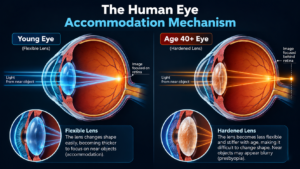
How Healthy Near Vision Works
Young, Elastic Lens ──> Ciliary Muscles Contract ──> Lens Curves & Thickens ──> Light Focuses Exactly on Retina

How Presbyopia Changes Focus After 40
Hardened Ciliary Lens ──> Ciliary Muscles Contract ──> Lens Remains Rigid ──> Light Focuses BEHIND Retina (Near Blur)
The Biological Engine Behind the Blur
To view near objects clearly, your eye must undergo a mechanism called accommodation:
The Young Eye: In children and young adults, the natural crystalline lens located behind the pupil is soft, gel-like, and extremely flexible.
The Focusing Action: When you switch your gaze from a far wall to a book, tiny ring-like muscles called ciliary muscles contract. This allows the flexible lens to curve and increase its optical power.
The Aging Lens: As we age, proteins inside the crystalline lens gradually cross-link and harden. By age 40 to 45, the lens loses its elasticity. Even though the ciliary muscles still squeeze normally, the hardened lens can no longer bend enough to bring near light rays into sharp focus on the retina.
Early Symptoms: Recognizing When Your Eyes Need Assistance
Presbyopia typically creeps in over a period of months rather than happening overnight. Many adults initially write off the early warning signs as mere fatigue or working too late at a computer screen.
Common Signs You Are Developing Presbyopia
| Clinical Symptom | Daily Real-World Impact | Why It Happens |
| “Arm-Length Extension” | Stretching your arm out completely to read text messages or medicine labels | Pushes the object back to match your receded near point of focus |
| Eyestrain & Brow Aching | A dull headache around your temples after 20 minutes of reading | Ciliary muscles overworking continuously to flex a hardened lens |
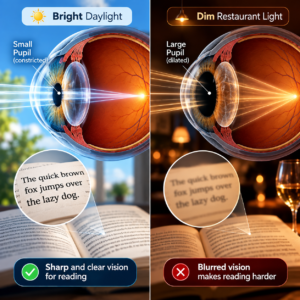
| Lighting Cravings | Needing brighter, direct lamps or sunlight to read small print | Bright light shrinks your pupil, creating a “pinhole effect” that sharpens focus |
| Transient Focus Blur | Looking up from a laptop to a clock on the wall takes 2–3 seconds to clear | Delayed relaxation of the visual accommodation system |
| Low-Light Visual Decline | Extreme difficulty reading menus in dim ambient restaurant lighting | Pupil dilates in low light, removing the protective depth of field |

Presbyopia vs. Hyperopia vs. Myopia vs. Cataracts
Because many vision conditions involve blurred sight, it is vital to understand where presbyopia sits among common ocular issues.
| Condition | Primary Structural Cause | Characteristic Visual Profile |
|---|---|---|
| Presbyopia | Age-related loss of lens flexibility | Blurry near vision, typically starting after age 40 |
| Hyperopia | Eyeball axial length is too short | Blurry near vision, often present since youth |
| Myopia | Eyeball axial length is too long | Clear near vision but blurry distance vision |
| Cataracts | Clouding of the lens proteins | Overall hazy or dim vision with significant glare |
1. Presbyopia vs. Hyperopia (Farsightedness)
Hyperopia is a structural refractive error present from childhood where the physical eyeball is shorter than average.
Presbyopia is a functional aging process of the internal lens. You can have perfect 20/20 distance vision all your life and still develop presbyopia at age 42.
2. Presbyopia vs. Myopia (Nearsightedness)
If you are already nearsighted (myopic), you can often read clearly simply by taking off your distance glasses. However, your internal lens is still stiffening at the exact same rate.
3. Presbyopia vs. Cataracts
Presbyopia only affects lens flexibility (focusing power).
Cataracts involve actual clouding and discoloration of the lens structure, causing overall dimness and glare. To learn more about lens clouding, explore our guide on Cataract Surgery Options and Intraocular Lens Selection.
Progressive Stages: How Presbyopia Evolves with Age
Presbyopia progresses naturally between ages 40 and 65 before eventually stabilizing. Understanding these stages helps you anticipate when your prescription power will need updating.
                              PRESBYOPIA AGE TIMELINE
                                         │
 ┌───────────────────────┬───────────────┴───────────────┬───────────────────────┐
 ▼                       ▼                               ▼                       ▼
Ages 40–44              Ages 45–49                      Ages 50–54              Ages 55–65+
Early Onset             Functional Stage                Advanced Stage          Absolute Stage
(+0.75D to +1.25D)      (+1.25D to +1.75D)              (+1.75D to +2.25D)      (+2.25D to +2.50D)
Stage 1: Incipient / Early Onset (Ages 40–44)
Power Requirement: $+0.75\text{ D}$ to $+1.25\text{ D}$
Experience: You can still read small text with extra effort or brighter light, but reading fine print after a long workday produces mild eye fatigue.
Stage 2: Functional Presbyopia (Ages 45–49)
Power Requirement: $+1.25\text{ D}$ to $+1.75\text{ D}$
Experience: Near tasks become impossible without corrective readers. Print at normal arm distance is noticeably blurry regardless of lighting.
Stage 3: Advanced Presbyopia (Ages 50–54)
Power Requirement: $+1.75\text{ D}$ to $+2.25\text{ D}$
Experience: The natural accommodation amplitude drops significantly. Intermediate distances—such as desktop monitors—start to feel strained as well.
Stage 4: Absolute Presbyopia (Ages 55–65+)
Power Requirement: $+2.25\text{ D}$ to $+2.50\text{ D}$ (Stabilized max add)
Experience: The natural crystalline lens has lost almost all internal elasticity. Near vision relies entirely on corrective optical lenses.
Modern Treatment Options: Finding the Right Optical Solution
You do not have to settle for basic “pharmacy magnifiers” that give you headaches. Modern optometry and ophthalmology offer customized solutions tailored to your occupation, digital screen demands, and active lifestyle.
Comparison of Presbyopia Optical Solutions
| Lens/Treatment Type | Primary Advantage | Best Suited For | Key Considerations |
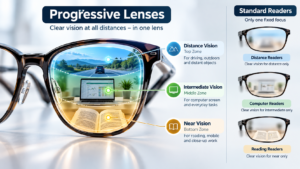
| Single-Vision Readers | Wide, uninterrupted field for close work | Dedicated readers, sewing, desk filing | Must be taken off when looking up at a distance |
| Progressive Lenses (PALs) | Seamless distance, intermediate, and near clarity | All-day wear, active professionals | Requires a 3–7 day brain adaptation period |
| Office/Computer Lenses | Wide intermediate zone optimized for screens | IT professionals, accountants, desk workers | Not designed for outdoor distance driving |
| Multifocal Contacts | No frame boundaries; natural peripheral vision | Athletes, active adults, social events | Requires adequate tear film and proper hygiene |
| Monovision Contacts | One eye distance, one eye near | Long-term contact users | May slightly reduce depth perception |
| Presbyopic IOL Surgery | Permanent correction during cataract or RLE care | Patients seeking independence from glasses | Requires comprehensive pre-surgical retina screening |
Why Custom Prescription Lenses Outperform OTC Readers
Over-the-counter (OTC) reading glasses apply the exact same magnification power to both lenses. However, most adults have subtle differences in refractive error between their left and right eyes. Furthermore, OTC readers do not correct for astigmatism nor do they align with your exact Pupillary Distance (PD), which can lead to optical distortion, dizziness, and strain over long hours.
If your daily screen exposure is causing severe dryness alongside focusing issues, review our dedicated resource on The 20-20-20 Rule: A Complete Guide to Preventing Digital Eye Strain.
What to Expect During an Eye Examination at Move & Shine
At Move & Shine Orthopedic Wellness & Eye Hospital in Uttarahalli, South Bangalore, an evaluation for presbyopia includes a holistic assessment of your ocular health.
Our optometry team evaluates your exact distance and near vision requirements using digital phoropters under standardized lighting to determine your precise spherical near-add prescription.
Dr. Dona Susan John examines your cornea, natural crystalline lens, and tear film stability to rule out early nuclear cataracts or co-existing dry eye disease.
Because glaucoma and retinal conditions increase in prevalence past age 40, we perform intraocular pressure checks and dilated retinal examinations to protect your long-term sight.
We guide you through selecting lens profiles—whether progressive, office, or multifocal options—tailored specifically to your daily computer distance, reading habits, and frame preferences.