Medically Reviewed by Dr. Dona Susan John, Eye Care Specialist at Move & Shine Last Updated: September 2026
Macular degeneration has earned a difficult nickname among eye specialists: the “silent vision thief.” It’s called this because in its early stages, it typically causes no pain, no redness, and often no noticeable symptoms at all — even as it gradually damages the part of your retina responsible for sharp, central vision. By the time most people notice something is wrong, the disease has often already progressed.
For Indians over 50, this matters more than most people realize. This guide covers what macular degeneration actually is, the warning signs worth watching for, what the research says about risk in the Indian population specifically, and what evidence-based treatment — including the often-misunderstood role of supplements — actually looks like.
What Is Macular Degeneration?
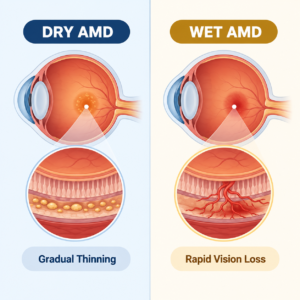
Age-related macular degeneration (AMD) affects the macula — the small central part of the retina responsible for the sharp, detailed vision you use for reading, recognizing faces, and driving. AMD typically begins with the buildup of small deposits called drusen beneath the retina, and comes in two forms:
- Dry AMD — the more common form, involving gradual thinning of macular tissue over time
- Wet AMD — less common but more aggressive, involving abnormal blood vessel growth beneath the retina that can cause rapid vision loss if untreated
Globally, the number of people living with AMD was projected to reach 196 million by 2020, growing to an estimated 288 million by 2040 — a scale that makes early detection genuinely important at a population level, not just an individual one.
Why It’s Called the “Silent” Vision Thief
Unlike conditions such as cataracts, which cause a gradual, noticeable clouding of vision, early-stage AMD frequently produces no symptoms at all. The macula is small, and the brain is remarkably good at “filling in” gaps in central vision using information from the surrounding areas — which means significant damage can occur before a person consciously notices anything has changed.
This is precisely why routine eye examinations after age 50 matter more than waiting for symptoms to appear.
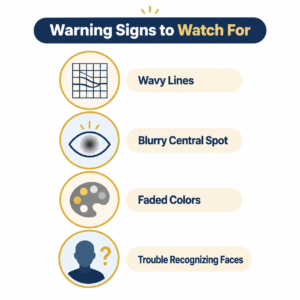
Warning Signs to Watch For
| Warning Sign | What It Might Indicate |
|---|---|
| Straight lines appearing wavy or bent | A classic early sign of AMD, often first noticed with door frames or window blinds |
| A blurry or blank spot in central vision | May indicate progression to a more advanced stage |
| Colors appearing less vivid or bright | Reduced macular function affecting color perception |
| Difficulty recognizing faces at a normal distance | Central vision loss affecting fine detail recognition |
| Needing brighter light for reading | Reduced contrast sensitivity, a subtle early indicator |
| Difficulty adapting when moving from bright to dim settings | Reduced macular and photoreceptor function |
If you notice any of these — even mildly, even intermittently — it’s worth having a dilated eye examination rather than waiting to see if it worsens.
Macular Degeneration in India: What the Research Shows
AMD research specific to India has grown substantially in recent years. A hospital-based study in Maharashtra examined AMD prevalence and determinants specifically in the Indian population aged 50 and older, and the India Age-Related Eye Disease Study (INDEYE) — conducted across sites including AIIMS Delhi and Aravind Eye Hospital in Tamil Nadu — has investigated both prevalence and genetic risk factors for AMD in Indian patients specifically, including variants in the ARMS2/HTRA1 genes associated with late-stage disease.
Notably, Indian research has also found that cataract surgery is associated with a higher risk of subsequently developing AMD — which is one of several reasons a comprehensive eye examination, rather than a narrow focus on a single condition, matters for anyone over 50.
Evidence-Based Treatment: What the AREDS2 Formula Actually Shows
For patients with intermediate or advanced AMD, the most well-established evidence-based intervention comes from two major U.S. National Eye Institute clinical trials: the Age-Related Eye Disease Study (AREDS) and its follow-up, AREDS2.
The original AREDS formula — vitamin C, vitamin E, beta-carotene, and zinc — was shown to reduce the risk of progression to advanced AMD by approximately 25% over five years in appropriate patients. The follow-up AREDS2 study replaced beta-carotene with lutein and zeaxanthin (after beta-carotene was found to increase lung cancer risk in smokers), and a long-term follow-up analysis published in JAMA Ophthalmology confirmed the updated formula was more effective at reducing AMD progression while avoiding that cancer risk.
It’s important to be precise about what this treatment can and cannot do: AREDS2 supplements are specifically for people who already have intermediate or advanced AMD in one or both eyes — they have not been shown to prevent early AMD from developing in the first place, and they are not a substitute for regular monitoring by an eye specialist.
The Role of Evidence-Based Supplement Formulations
This is where the science has genuinely advanced in recent years, and where a lot of confusion exists among patients choosing between supplement brands.
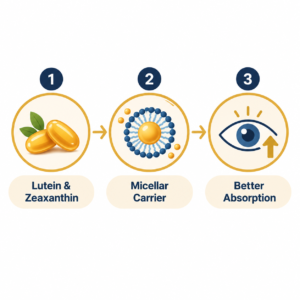
Lutein and zeaxanthin — the key AREDS2 ingredients beyond basic vitamins — have a well-documented absorption problem: they have poor natural water solubility and depend heavily on dietary fats for proper intestinal absorption, which means two people taking the “same” dose can end up with very different blood levels depending on the formulation and how it’s taken.
Micellar and liposomal formulations exist specifically to address this problem. In a randomized, double-blind, placebo-controlled trial, a micromicellar formulation of lutein, zeaxanthin, and meso-zeaxanthin produced significantly higher serum concentrations of zeaxanthin and meso-zeaxanthin compared to standard oil-based formulations of the same nutrients. Separately, pharmacokinetic research comparing lutein-zeaxanthin delivery systems has found that phospholipid and liposomal carriers meaningfully improve absorption compared to conventional oil-based formulations, by improving how the nutrients are solubilized and transported across the intestinal wall. In one human bioavailability study, an optimized lutein-zeaxanthin formulation achieved more than double the serum lutein concentration and 1.5 times the serum zeaxanthin concentration compared to a conventional formulation of the same nutrients.
What this means practically: if you’re taking a lutein/zeaxanthin supplement for eye health, the formulation matters as much as the dose on the label. A poorly absorbed formulation may deliver only a fraction of its stated dose into your bloodstream — and ultimately, into your macula, where it’s actually needed.
A Note on Omega-3 Fatty Acids
Omega-3 fatty acids are sometimes marketed alongside AMD supplements, and while some observational research has linked higher omega-3 intake to reduced AMD risk, the AREDS2 trial itself found that adding omega-3 supplementation did not reduce progression to advanced AMD. This is a good example of why it’s worth discussing specific supplement choices with your eye specialist rather than assuming every “eye health” ingredient has equally strong evidence behind it.
Lifestyle Factors That Support Macular Health
Beyond supplementation, research consistently points to a combination of lifestyle factors associated with lower AMD prevalence:
- Avoiding smoking
- Regular physical activity
- A diet resembling the Mediterranean pattern — rich in leafy greens, fish, and healthy fats
- Managing cardiovascular risk factors like blood pressure and cholesterol, since AMD shares some risk pathways with vascular disease
Macular Degeneration and Diabetes
People with diabetes require particular attention to macular health, since diabetic retinopathy and AMD can occur together and sometimes complicate each other’s diagnosis and management. If you have diabetes, a comprehensive eye exam should specifically screen for both conditions. Learn more in our diabetic retinopathy resources.
If you’re also managing cataracts alongside AMD risk — which Indian research suggests may be linked — our guide on Cataract Surgery in Bangalore covers what that evaluation and treatment process involves.
When to See an Eye Specialist
Don’t wait for symptoms to interfere with daily life. Book a comprehensive dilated eye examination if:
- You are over 50 and haven’t had an eye exam in the past year
- You’ve noticed any of the warning signs listed above, even mildly
- You have a family history of AMD
- You have diabetes, high blood pressure, or a history of smoking
- You’ve previously had cataract surgery
Why Choose Move & Shine for Macular Degeneration Care
Move & Shine Eye Clinic is one of the leading eye care centres in South Bangalore, located on Uttarahalli Main Road. Our eye care is led by Dr. Dona Susan John, an experienced ophthalmologist and medical retina specialist who has treated over 5,000 patients since 2017, with a particular focus on retinal conditions including macular degeneration and diabetic eye disease.
If you’re searching for an eye specialist in Bangalore for a comprehensive AMD evaluation, or want clarity on which supplements are genuinely evidence-based for your specific stage of AMD, our team can help you make an informed decision rather than guessing based on product marketing.
Learn more about Dr. Dona Susan John’s full profile.
Our Eye Care Services
- Comprehensive dilated eye examinations
- Macular degeneration screening and management
- Diabetic retinopathy screening
- Cataract evaluation and surgery
- Glaucoma screening
- Retinal imaging and OCT scanning
Explore our full range of eye care services →
Frequently Asked Questions
1. What is the first sign of macular degeneration? One of the earliest and most recognizable signs is straight lines appearing wavy or bent — often first noticed with door frames, window blinds, or ruled paper. Many people also notice needing brighter light for reading.
2. At what age should I start getting screened for macular degeneration? Most eye specialists recommend a comprehensive dilated eye exam starting at age 50, or earlier if you have a family history of AMD, diabetes, or other risk factors.
3. Can macular degeneration be cured? There is currently no cure for AMD, but treatment — including the AREDS2 supplement formula for appropriate patients and specific therapies for wet AMD — can slow progression and, in the case of wet AMD, help preserve remaining vision.
4. Is macular degeneration common in India? Research specific to the Indian population, including hospital-based studies in Maharashtra and the multi-site INDEYE study, has documented meaningful AMD prevalence and identified genetic risk factors relevant to Indian patients specifically.
5. Do AREDS2 supplements work for everyone with AMD? No. AREDS2 supplements are specifically studied for people with intermediate or advanced AMD in one or both eyes. They have not been shown to prevent early AMD from progressing to intermediate stages, and aren’t a general preventive supplement for people without AMD.
6. Why do some lutein and zeaxanthin supplements work better than others? Lutein and zeaxanthin have inherently poor water solubility and depend on dietary fat for absorption. Research shows that micellar and liposomal formulations can significantly improve how much of these nutrients actually reach your bloodstream compared to standard oil-based capsules, even at the same labeled dose.
7. Should I take omega-3 supplements for macular degeneration? The evidence is mixed. While some observational studies link higher omega-3 intake to lower AMD risk, the AREDS2 clinical trial specifically found that adding omega-3 supplementation did not reduce progression to advanced AMD. Discuss this specifically with your eye specialist.
8. Can diabetes affect my risk of macular degeneration? Diabetes and AMD can occur together and share some overlapping risk factors, which is why a comprehensive eye exam for diabetic patients should specifically screen for both diabetic retinopathy and AMD.
9. Is wet or dry macular degeneration more serious? Wet AMD is less common but tends to progress faster and can cause more rapid vision loss if untreated, since it involves abnormal blood vessel growth. Dry AMD is more common and generally progresses more gradually, though it can still lead to significant vision loss over time.
10. Can cataract surgery increase my risk of macular degeneration? Some Indian research has found an association between cataract surgery and a subsequently higher risk of AMD diagnosis, which is one reason ongoing retinal monitoring after cataract surgery is worthwhile.
11. What lifestyle changes actually help protect against macular degeneration? Not smoking, staying physically active, following a Mediterranean-style diet rich in leafy greens and fish, and managing cardiovascular risk factors like blood pressure and cholesterol are all associated with lower AMD prevalence in research.
12. Where can I get a comprehensive macular degeneration screening in Bangalore? Move & Shine Eye Clinic, located on Uttarahalli Main Road, offers comprehensive dilated eye examinations and macular degeneration screening led by Dr. Dona Susan John.
This article is for general informational purposes and does not replace a professional eye examination. Please consult your eye specialist before starting any new supplement, particularly if you are a smoker, as some AMD-related supplement ingredients require careful consideration in that context.
Sources
- National Eye Institute — AREDS2 Supplements for Age-Related Macular Degeneration
- BrightFocus Foundation — New Study Confirms the Efficacy of AREDS2 Eye Vitamin Supplement
- PMC — Nutritional and Lifestyle Interventions for Age-Related Macular Degeneration: A Review
- Antioxidants (MDPI) — The Impact of Formulation on Lutein, Zeaxanthin, and meso-Zeaxanthin Bioavailability: A Randomised Double-Blind Placebo-Controlled Study
- PMC — Superior Bioavailability of a Novel Lutein and Zeaxanthin Formulation in Healthy Human Subjects
- Indian Journal of Ophthalmology — Prevalence of Age-Related Macular Degeneration and Associated Risk Factors
- PMC — Genetic Risk Factors for Late Age-Related Macular Degeneration in India