Medically Reviewed by Dr. Pradeep Kocheeppan, Knee & Shoulder Surgeon, Move & Shine Orthopedic Wellness & Eye Hospital | Last Updated: August 2026
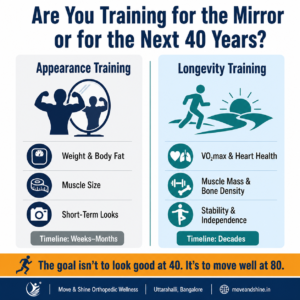
Two people walk into a gym. One is 34, training for aesthetics — a defined abdomen, bigger arms, a more impressive physique before a wedding or reunion. The other is 52, training because their orthopaedic surgeon told them their knees will thank them in twenty years, and that whether they can still climb stairs, get up off the floor, and walk without pain at 80 depends far more on what they do with their muscles, bones, and joints today than on anything else.
Both are exercising. Neither is doing it wrong. But they are training for entirely different outcomes — and most people don’t realise the difference until their body makes it unmistakably clear somewhere in their 40s or 50s.
Longevity training is one of the most searched and most misunderstood concepts in wellness today. A 2026 Life Time Wellness Survey found that 82% of respondents now rank strength training and longevity as their top fitness priorities — yet the majority are still training as if appearance is the primary goal, without any real attention to the musculoskeletal system that ultimately determines whether they’ll be independently mobile decades from now. This guide focuses specifically on what the science says about training your muscles, bones, and joints for a long, functional life — and what that framework looks like for Indian adults in their 30s, 40s, 50s, and beyond.
The Core Distinction: Healthspan vs Lifespan
Before we discuss training methods, we need to establish a critical distinction. Lifespan is how long you live. Healthspan is how long you live well — moving freely, climbing stairs without pain, getting up off the floor unassisted, and functioning independently.
Most conventional fitness training optimises for appearance in the short term. Musculoskeletal longevity training optimises for the structures that carry you through decades — your muscles, your bones, and your joints. The two approaches sometimes overlap, but they diverge in what they prioritise, how they manage load and recovery, and what they’re willing to sacrifice now to preserve function later.
“The patients I see who are most functional in their 60s and 70s are not the ones who looked the best in their 30s and 40s. They are the ones who prioritised joint health, maintained their muscle mass through their 40s and 50s, and kept moving consistently without overloading their structures. Looking good is a side effect of training well — not the primary goal if longevity is what you care about.”
— Dr. Pradeep Kocheeppan, Orthopaedic Surgeon (Knee & Shoulder Specialist), Move & Shine Orthopedic Wellness & Eye Hospital, Bangalore
The Science: What Actually Predicts Long-Term Musculoskeletal Health?
The research on healthy aging has converged on a small number of physiological markers, specific to muscle, bone, and joint function, that predict long-term independence more reliably than almost anything else.
1. Muscle Mass and Strength
After age 30, adults lose 3% to 8% of muscle mass per decade, with the rate accelerating sharply after 60 — a process called sarcopenia. Muscle mass predicts not just strength but also fall risk, recovery from illness and surgery, and the ability to perform basic daily tasks independently in later life.
Critically, muscle mass built in your 40s and 50s acts as a “reserve tank” for the accelerated losses of your 60s and 70s. Conventional training often de-prioritises muscle maintenance in favour of aesthetic goals — musculoskeletal longevity training treats muscle mass as a non-negotiable long-term asset. Our detailed guide on Strength Training After 40: Defying Sarcopenia and Bone Decay covers the orthopedic perspective on muscle and bone preservation in depth.
2. Bone Mineral Density
Bone density peaks around age 30 and gradually declines afterward, with the decline accelerating significantly in postmenopausal women due to falling oestrogen levels. Weakened bone density — osteopenia and eventually osteoporosis — dramatically increases fracture risk from falls that a younger or stronger skeleton would absorb without injury.
The encouraging evidence: resistance and weight-bearing exercise directly stimulates bone formation. A systematic review and network meta-analysis found that moderate-intensity resistance training performed three days a week measurably improved bone mineral density, particularly in the lumbar spine, with more recent trials also demonstrating benefits at the hip and femur when training is progressive and well-structured. Weight-bearing aerobic activities — walking, hiking, stair climbing — provide an additional, complementary stimulus for bone formation in the lower body.
3. Grip Strength
Grip strength is one of the most validated biomarkers of overall musculoskeletal health. A large prospective study in The Lancet found that each 5 kg reduction in grip strength was associated with a 17% higher risk of cardiovascular mortality and a 16% higher risk of all-cause mortality. Grip strength reflects not just hand and forearm function, but overall muscle quality and systemic musculoskeletal aging.
4. Balance and Fall Prevention
Falls are the leading cause of injury-related death in adults over 65 in India. The ability to stand on one leg for 10 seconds at age 50–60 is associated with significantly lower all-cause mortality risk, according to a 2022 study published in the British Journal of Sports Medicine. Balance is a trainable quality, directly tied to joint proprioception and lower-limb strength, that most people ignore entirely until after their first fall.
5. Joint Range of Motion and Cartilage Health
Joint mobility — how freely your hips, knees, shoulders, and spine move through their full range — determines which forms of exercise remain accessible to you as you age. Restricted joint mobility doesn’t just limit training; it limits daily function: reaching overhead, squatting to pick something up, or turning to check a blind spot while driving.
The 4-Pillar Musculoskeletal Longevity Framework
Musculoskeletal longevity training is not a single workout. It is a framework built on four pillars, each targeting a different structure that determines how long you move well.
Pillar 1: Strength Training — The Muscle Mass Reserve
Strength training for longevity is not bodybuilding. The goal is not maximal muscle size for aesthetic reasons — it is maintaining functional muscle mass, joint-supporting strength, and movement capacity across multiple planes of motion.
A 2026 Harvard study on exercise variety found that participants who engaged in the highest variety of exercise modalities had a 19% lower risk of premature death compared to those who performed only one type of exercise, with strength training a consistent contributor to that benefit.
Longevity-focused strength training priorities:
- Compound movements — squats, deadlifts, presses, rows, and carries work multiple joints simultaneously and build the functional strength daily life demands
- Single-leg work — lunges, step-ups, and single-leg squats build the balance and lower-limb strength that prevents falls
- Hip hinge patterns — Romanian deadlifts and hip thrusts protect the lower back and build posterior chain strength that deteriorates with prolonged sitting
- Grip and carry work — farmer’s carries build grip strength and functional full-body stability
- Frequency — 2–3 sessions per week, with emphasis on progressive overload over months and years, not just weeks
Strength training after 40 has specific considerations — joint loading, hormonal changes, recovery capacity, and bone density all shift in ways that affect programme design. Read our comprehensive guide on Strength Training After 40 for the full orthopedic perspective on building and maintaining muscle through midlife and beyond.
Pillar 2: Bone Health — Training for Skeletal Strength
Bone doesn’t respond to exercise the way muscle does — it needs mechanical loading specifically, not just general activity, to trigger new bone formation. This is why bone health deserves its own dedicated place in a musculoskeletal longevity programme rather than being treated as an automatic byproduct of “staying active.”
Evidence-based approaches for bone density:
- Progressive resistance training — squats load the hips and lumbar spine; deadlifts load the spine and hips together; overhead pressing loads the shoulders and upper spine
- High-impact weight-bearing activity, where appropriate — activities like brisk walking, stair climbing, and (for those without joint contraindications) light jogging or jump training stimulate bone formation in the lower body through mechanical impact
- Consistency over years, not weeks — bone remodelling is a slow process; meaningful density changes are measured over 6-month to multi-year timeframes, not weeks
“Bone health is the part of longevity training people think about the least — until a fracture forces them to. The good news is that unlike some aspects of aging, bone density responds directly to the loads we place on it. A well-designed strength programme is one of the few interventions that actually builds the skeleton back up, not just slows its decline.”
— Dr. Pradeep Kocheeppan, Orthopaedic Surgeon, Move & Shine Orthopedic Wellness & Eye Hospital
Pillar 3: Joint Health — The Limiting Factor
Here is what distinguishes the Move & Shine perspective on longevity training from a general fitness blog: joints are the limiting factor. You can have perfect strength programming and ideal bone-loading protocols — but if your knees, hips, shoulders, or spine are compromised, you cannot execute the training that longevity requires.
Joint health and longevity training are inseparable. Protecting your joints through your 40s and 50s is what allows you to exercise consistently through your 60s and 70s. The most common reason people stop training as they age is not lack of motivation — it is pain, injury, and structural limitations that could have been prevented or managed earlier.
Knee Health and Longevity
The knee is the most loaded joint in the human body during exercise and the most commonly affected by osteoarthritis in India, with prevalence rising to over 64% among elderly Indians. Longevity training must include progressive loading that builds cartilage-supporting muscle around the knee, avoidance of high-impact loading on already-compromised knee structures, and early management of knee pain before it becomes irreversible. Read our guides on Healthy Knees, Healthy Heart: Joint Preservation Habits and Will Every Knee Pain Patient Need Knee Replacement Surgery? for the clinical perspective.
Hip Health and Longevity
Hip strength, mobility, and stability are foundational to virtually every longevity training activity — walking, squatting, climbing stairs, getting up from the floor. Hip dysfunction also creates downstream knee and back problems that compound over time. Maintaining hip mobility and glute strength through targeted exercises is one of the most important investments in musculoskeletal longevity.
Shoulder Health and Longevity
The shoulder’s unparalleled mobility makes it the most injury-prone joint in the upper body. Rotator cuff degeneration, frozen shoulder, and impingement all become more common with age — and all limit the upper-body strength training that longevity requires. Our guides on Shoulder Pain Causes and Treatment and Rotator Cuff Injuries: Why They Happen and How to Prevent Them cover the orthopedic management of shoulder conditions that affect training capacity.
Spine and Back Health
The spine is the axis around which all longevity training movements occur. Chronic back pain — one of the most common reasons people stop exercising — is almost always manageable with the right combination of movement, strength, and mobility work. Stopping exercise because of back pain is usually the wrong response. Read our guide on Understanding Back Pain: When Simple Treatment Is Enough to understand when physiotherapy is the answer and when more intervention is needed.
Pillar 4: Mobility, Balance, and Stability — The Foundation Under Everything
This is the pillar most people completely ignore — and the one that makes the biggest practical difference in quality of life as you age.
- Joint mobility work — maintaining full range of motion in hips, shoulders, thoracic spine, and ankles through targeted mobilisation exercises
- Balance training — single-leg balance, stability challenges, and progressively demanding balance tasks that train the vestibular, visual, and proprioceptive systems simultaneously
- Core stability — not crunches and sit-ups, but anti-rotation and anti-extension work (planks, pallof presses, dead bugs) that builds the deep stability system supporting the spine
- Postural correction — addressing the forward head, rounded shoulders, and anterior pelvic tilt that develop from years of desk work and accumulated sitting
Yoga is an increasingly recognised tool for this pillar specifically. Our guide on Yoga for Joint Health After 40 covers how yoga-based movement contributes to joint preservation, balance, and mobility in the context of orthopedic wellness. It’s worth noting, however, that yoga alone does not provide sufficient mechanical loading for muscle mass and bone density preservation — it is a powerful complement to, not a replacement for, the strength and bone-loading pillars above.
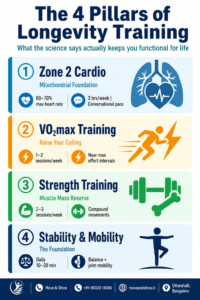
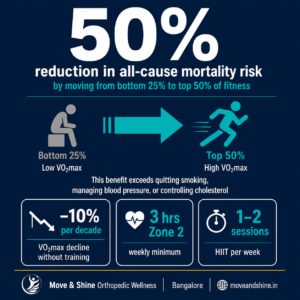
The science-backed longevity training framework: Zone 2 cardio builds your mitochondrial base, VO2max work raises your ceiling, strength training preserves muscle mass, and stability work keeps you injury-free for decades.
“Mobility work is the pillar patients skip most often, because the payoff isn’t visible the way strength gains are. But I can tell within minutes of an assessment whether someone has maintained their joint mobility over the years or not — it shows in how they sit, stand, and move through a simple squat. It is genuinely one of the best investments you can make in your 40s for how you’ll feel in your 60s.”
— Dr. Pradeep Kocheeppan, Orthopaedic Surgeon, Move & Shine Orthopedic Wellness & Eye Hospital
Longevity Training vs Appearance Training: The Key Differences
Dimension | Appearance Training | Musculoskeletal Longevity Training |
Primary goal | Look better | Move well for longer |
Time horizon | Weeks to months | Decades |
Strength priority | Hypertrophy (muscle size) | Functional strength + bone density |
Bone health | Rarely addressed directly | Central, deliberate training target |
Joint approach | Often ignored | Central to programme design |
Missing pillars | Mobility, balance, bone loading | None — all four included |
Injury tolerance | Push through pain | Pain is a signal to assess |
Recovery view | Inconvenience | Non-negotiable training input |
Metrics tracked | Mirror, scale, measurements | Bone density, grip strength, balance, joint range of motion |
Musculoskeletal Longevity by Decade: What Matters Most at Each Stage
Your 30s: Build the Foundation
The 30s are the decade where the foundations that will matter most in your 50s and 60s are set — for both muscle and bone.
- Establish consistent strength training with progressive overload — build as much muscle mass and bone density as possible while your body’s natural capacity supports it
- Address postural imbalances from desk work before they become structural problems
- Prioritise sleep and recovery — tissue and bone regeneration happen during rest, not during training
- Get a movement assessment if you have recurring pain — small corrections in your 30s prevent major problems in your 50s
Your 40s: The Critical Decade
The 40s are when the consequences of training choices in the 30s — or the lack of them — begin to appear. Hormonal shifts (declining oestrogen in women, declining testosterone in men) accelerate both muscle and bone loss. Joint wear becomes more noticeable.
- Double down on protein intake — the anabolic resistance of aging muscle means 1.6–2.0g of protein per kg body weight is needed to maintain muscle mass in the 40s versus less in the 20s
- Add dedicated balance work — begin single-leg and stability training before balance deterioration becomes noticeable
- Shift toward higher-intensity, lower-volume strength training — quality of stimulus matters more than volume as recovery capacity declines
- Manage joint load proactively — if joints ache after exercise, this is not “normal aging”; it is a signal requiring assessment
Your 50s and Beyond: Protect What You Have Built
The 50s and beyond require a shift in training philosophy: from building to maintaining, and from performance to function.
- Prioritise mobility and balance as equal pillars alongside strength
- Reduce impact loading on compromised joints — swimming, cycling, and resistance machines allow high training stimulus with lower joint stress, while weight-bearing walking is still preserved for bone benefit where joints tolerate it
- Make strength training non-negotiable — the loss of muscle mass accelerates in the 50s; 2–3 sessions weekly are the minimum effective dose
- Consider an annual health and movement assessment — catching declining bone density or emerging joint issues early allows intervention before they become limiting
An annual Orthopedic Wellness assessment at Move & Shine provides a structured evaluation of joint health, movement quality, and musculoskeletal risk factors — giving you a clear, clinically grounded picture of what your longevity training should address.
Nutrition for Musculoskeletal Longevity
Exercise creates the stimulus for stronger muscles, bones, and joints; nutrition provides the substrate for that adaptation to actually happen.
Protein — The Non-Negotiable
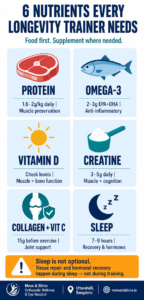
The anabolic resistance that develops with age means older adults need more protein per kilogram of body weight than younger adults to achieve the same muscle protein synthesis response to exercise. Current evidence supports 1.6–2.0g protein per kg body weight daily, distributed across at least 3–4 meals with a minimum of 30–40g of protein per meal.
Calcium and Vitamin D — The Bone-Building Pair
Calcium is the primary structural mineral in bone, and Vitamin D is essential for its absorption. Vitamin D deficiency is endemic in urban India despite year-round sunshine, primarily due to indoor lifestyles and sun avoidance. Serum levels below 30 ng/mL, common in the urban Indian population, are associated with reduced muscle strength, poorer bone health, and increased fall risk. Testing and supplementing when deficient is one of the highest-leverage steps for musculoskeletal longevity.
Collagen + Vitamin C — Joint and Tendon Support
Tendons, ligaments, and joint cartilage are collagen-based structures that become less resilient with age and more susceptible to injury under training load. 15g of hydrolysed collagen peptides with 200–500mg of Vitamin C, taken 30–60 minutes before exercise, has been shown to increase collagen synthesis in tendons and ligaments — a particularly relevant addition for anyone training through or recovering from joint issues.
VO2max longevity infographic showing 50% reduction in all-cause mortality risk from improving cardiorespiratory fitness — longevity training data visual from Move & Shine Orthopedic Wellness Hospital Bangalore
The Role of Physiotherapy and Orthopedic Guidance
Musculoskeletal longevity training is not something most people should design entirely on their own — particularly if they are starting after 40, have existing joint conditions, or have been sedentary for years. Professional guidance adds:
- Movement assessment — identifying compensations, weaknesses, and mobility restrictions before they cause injury under training load
- Exercise prescription — designing the specific programme that matches your current joint health, bone density status, and longevity goals
- Injury management — ensuring minor problems are addressed before they become chronic limitations
- Progressive overload planning — structuring safe increases in training stimulus over months and years without overloading vulnerable joints
- Return to training after injury or surgery — ensuring recovery restores full function, not just the absence of pain
At Move & Shine, our Physiotherapy and Exercise Training service integrates clinical physiotherapy with exercise prescription, providing the clinical oversight musculoskeletal longevity training requires alongside the practical guidance that makes it sustainable.
“The single biggest mistake I see is patients treating pain as something to push through rather than a signal to investigate. In musculoskeletal longevity training, pain isn’t weakness leaving the body — it’s information. Listening to it early is what keeps people training consistently for decades instead of stopping for months at a time to recover from a preventable injury.”
— Dr. Pradeep Kocheeppan, Orthopaedic Surgeon, Move & Shine Orthopedic Wellness & Eye Hospital
The question of when professional intervention is essential — rather than optional — is explored in depth in our article Why Physiotherapy Is as Important as Surgery — If Not More.
Longevity training by decade infographic — what to prioritise in your 30s, 40s, 50s and 60s for lifelong fitness and joint health — exercise roadmap from Move & Shine Orthopedic Wellness Uttarahalli Bangalore