Medically Reviewed by Dr. Viresh Murgodi, Orthopedic Surgeon at Move & Shine Last Updated: July 2026

If your first few steps out of bed each morning come with a sharp, stabbing pain in your heel, you’re not alone. This is one of the most recognizable signs of plantar fasciitis — the most common cause of heel pain, affecting an estimated 2 million people every year. The good news is that more than 90% of cases improve with simple, non-surgical treatment. This guide covers what causes it, how it’s treated, and — most importantly — when it’s time to stop self-managing and see an orthopedic specialist.
What Is Plantar Fasciitis?
The plantar fascia is a strong, thin band of tissue that runs along the bottom of your foot, connecting your heel bone to your toes and supporting your foot’s arch. According to the American Academy of Orthopaedic Surgeons (AAOS), plantar fasciitis occurs when this band becomes irritated and inflamed from repeated stress and strain, most commonly at the point where it attaches to the heel bone.
A common myth is that plantar fasciitis is caused by heel spurs. In reality, the AAOS notes that while roughly 1 in 10 people have heel spurs, only about 1 in 20 people with a heel spur actually experience foot pain — meaning the spur itself is rarely the real cause of the discomfort.
What Causes Plantar Fasciitis?
Plantar fasciitis develops from repetitive strain on the plantar fascia rather than a single injury. Common contributing factors include:
- Sudden increases in activity — starting a new running routine, or rapidly increasing distance or intensity, is one of the most common triggers
- Prolonged standing — occupations that involve standing on hard surfaces for long hours (retail workers, teachers, factory staff) carry higher risk
- Foot mechanics — flat feet, high arches, or an abnormal walking pattern can place uneven stress on the fascia
- Improper or worn-out footwear — shoes lacking arch support or cushioning fail to absorb the daily stress placed on the foot
- Being overweight — added body weight increases the load on the plantar fascia with every step
- Tight calf muscles or Achilles tendon — reduced flexibility in the lower leg increases strain transferred to the foot

According to the American Orthopaedic Foot and Ankle Society, active men and women between ages 40 and 70 are among the most commonly affected groups, though runners and people who are on their feet for long stretches of the day can develop it at any age.
Common Symptoms of Plantar Fasciitis
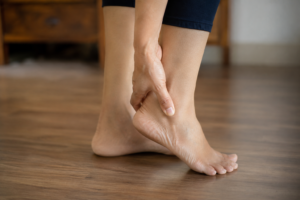
- Sharp, stabbing heel pain, most noticeable with your very first steps in the morning
- Pain that decreases with activity but returns after long periods of standing or sitting
- Pain that worsens after (not necessarily during) exercise
- Discomfort concentrated on the bottom of the heel, sometimes extending toward the arch
If these symptoms persist for more than a few weeks despite rest, it’s a sign that professional evaluation is needed rather than continuing to self-manage.
A Quick Self-Check
Ask yourself the following questions. If you answer “yes” to two or more, plantar fasciitis is a strong possibility worth having evaluated:
- Is your heel pain worse with your very first steps in the morning, easing slightly as you move around?
- Does the pain return after standing or sitting for long periods, even if it improved earlier in the day?
- Have you recently increased your walking, running, or standing time significantly?
- Are your current shoes worn out, unsupportive, or lacking cushioning?
- Is the pain concentrated specifically at the bottom of your heel, rather than spreading across your whole foot?
When to See an Orthopedic Doctor
Many mild cases of plantar fasciitis improve with home care. However, you should schedule a consultation with an orthopedic specialist if:
- Heel pain persists beyond 2–3 weeks despite rest, stretching, and supportive footwear
- Pain is severe enough to affect your walking pattern or daily activities
- You notice swelling, redness, or warmth around the heel (which could indicate a different underlying issue)
- You have numbness or tingling alongside the heel pain
- Pain returns repeatedly despite previous treatment
A proper evaluation is important because several other conditions — including stress fractures, tarsal tunnel syndrome, and nerve entrapment — can mimic plantar fasciitis symptoms, and treating the wrong condition delays real recovery.
“Heel pain is one of the most under-treated conditions I see — patients often wait months, assuming it’s just part of being on their feet too much. The earlier we evaluate it properly, the faster and simpler the recovery usually is.” –
Dr. Viresh Murgodi
What Happens During an Orthopedic Evaluation
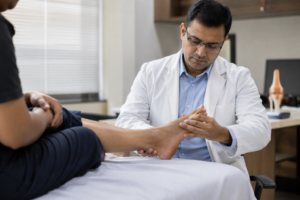
When you visit an orthopedic specialist for heel pain, the evaluation typically includes:
- A detailed history — when the pain started, what activities worsen it, and your footwear and exercise habits
- A physical examination — checking the specific location of tenderness, your foot’s arch structure, and calf flexibility
- A gait assessment — observing how you walk, since abnormal walking patterns can both cause and result from heel pain
- Imaging, if needed — X-rays or ultrasound are not always necessary, but may be used to rule out stress fractures or confirm the diagnosis in unclear cases
This structured evaluation is what allows a specialist to build a treatment plan around your specific cause, rather than applying generic advice that may not address your particular situation.
How Plantar Fasciitis Is Treated
Evidence consistently shows that non-surgical treatment resolves the vast majority of cases. Research published in the Journal of the American Academy of Orthopaedic Surgeons notes that non-surgical management is successful in approximately 90% of patients.
First-Line Treatments (Usually Tried First)
- Rest and activity modification — reducing high-impact activity temporarily to allow inflammation to settle
- Stretching exercises — specifically targeting the calf muscles and the plantar fascia itself, which are shown to meaningfully reduce symptoms over time
- Supportive footwear and orthotics — proper arch support redistributes pressure away from the inflamed area
- Ice application — reduces pain and inflammation, particularly after activity
- Night splints — keep the foot in a gently stretched position overnight, addressing the classic “first-step-in-the-morning” pain
Intermediate Treatments (For Cases That Don’t Resolve Quickly)
- Extracorporeal shockwave therapy (ESWT) — uses sound wave energy to stimulate healing in chronic cases
- Corticosteroid injections — can provide temporary relief for persistent inflammation, though repeated use carries risks and should be guided by a specialist (our detailed guide on corticosteroid injections covers how these are used more broadly in orthopedic care)
- Custom orthotic devices — designed specifically for your foot structure, offering more targeted support than off-the-shelf insoles
Surgical Treatment (Reserved for Persistent Cases)
According to the AAOS, surgery is generally only considered for patients who haven’t improved after 12 months of consistent, aggressive non-surgical treatment. Surgical options, such as partial plantar fascia release, are typically performed only after this extended period, reflecting how rarely surgery is actually needed for this condition.
“Surgery is rarely the answer for plantar fasciitis. In my experience, the vast majority of patients recover fully with the right combination of stretching, footwear correction, and patience.” –
Dr. Viresh Murgodi

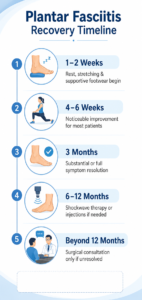
Recovery Timeline: What to Expect
| Timeframe | What’s Typically Happening |
|---|---|
| 1–2 weeks | Initial rest, stretching, and supportive footwear begin reducing morning pain intensity |
| 4–6 weeks | Consistent stretching and activity modification typically show noticeable improvement for most patients |
| 3 months | Most patients following a structured plan see substantial or complete symptom resolution |
| 6–12 months | Persistent cases may explore intermediate treatments like shockwave therapy or targeted injections |
| Beyond 12 months | Surgical consultation may be considered only if aggressive non-surgical treatment has not resolved symptoms |
Preventing Plantar Fasciitis From Returning
Since plantar fasciitis often stems from repetitive strain, prevention focuses on reducing that ongoing stress:
- Increase running distance or intensity gradually — the American Orthopaedic Foot and Ankle Society recommends increasing weekly mileage by no more than about 10%
- Replace worn-out athletic shoes regularly, particularly if you exercise frequently
- Maintain regular calf and foot stretching, even after symptoms resolve
- Consider supportive footwear or orthotics if you have flat feet or high arches
- Warm up properly before exercise and cool down afterward with gentle stretching
- Consider cross-training with lower-impact activities like swimming or cycling if you’re prone to recurring heel strain
Small, consistent habits — a few minutes of calf stretching each morning, checking your shoe cushioning every few months — tend to matter more for long-term prevention than any single treatment.
For more on how connected muscle groups affect lower-body injury patterns, our guide on the hidden link between hips, core, and hamstring injuries explores how imbalances elsewhere in the body can contribute to overuse injuries like this one. If you’re building a broader joint-health routine, our article on yoga for joint health after 40 also offers relevant, low-impact stretching guidance.
Why Choose Move & Shine for Plantar Fasciitis Treatment in Bangalore
Move & Shine Orthopedic Wellness Centre is one of South Bangalore’s leading orthopedic clinics, located on Uttarahalli Main Road. Our orthopedic care is led by specialists including Dr. Viresh Murgodi, whose experience spans sports medicine, joint care, and advanced trauma treatment — ensuring heel and foot pain is evaluated thoroughly rather than treated as an isolated symptom.
If you’re searching for plantar fasciitis treatment near me or the best orthopedic clinic in Bangalore for persistent heel or foot pain, our team can help identify the right combination of treatments for your specific case.
Heel pain that’s dismissed as “just part of getting older” or “normal after a long walk” often has a specific, treatable cause. Getting an accurate diagnosis early — rather than waiting months while self-managing with generic remedies — is usually what separates a quick recovery from a chronic, recurring problem.
Our Orthopedic Services
- Comprehensive orthopedic and sports injury evaluation
- Non-surgical pain management (injections, orthotics, physiotherapy referrals)
- Shockwave therapy for chronic musculoskeletal conditions
- Joint and ligament injury treatment
- Advanced trauma and fracture care
- Sports injury rehabilitation