You are 43. You are reading a restaurant menu and you find yourself angling it toward the light, then holding it slightly further away, then passing it to your dinner companion with a laugh: ‘the print is so small these days, isn’t it?’ It is not the print. It has not changed. Your eyes have.
Presbyopia reading glasses after 40 is one of the most searched eye care topics in India — and with good reason. According to the World Health Organization, presbyopia currently affects approximately 1.8 billion people worldwide, representing 25% of the global population, with projections showing this number reaching 2.1 billion by 2030. In India specifically, a cross-sectional study published in the National Center for Biotechnology Information (NCBI) found that 76.61% of patients aged 40 and above presented with symptoms related to presbyopia — making it the most common visual complaint in midlife Indian adults.
This guide is specifically about presbyopia — what it is, why it happens, how it differs from other eye conditions you may already have, what your correction options are, and when to see an eye specialist in Bangalore for a proper prescription. If you are looking for information about delaying glasses through lifestyle habits, myopia progression, or managing dry eyes from screen use, we have dedicated guides on those topics linked throughout.
What Is Presbyopia? The Anatomy of Why Reading Gets Harder After 40
The word presbyopia comes from the Greek presbus (‘old man’) and ops (‘eye’). It is the most common optical error in the human eye, characterised by a gradual, progressive reduction in the ability to focus clearly on close objects.
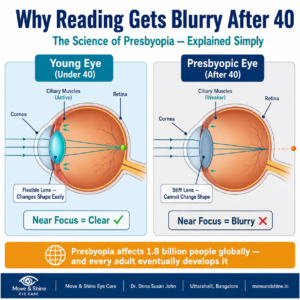
To understand presbyopia, you need to understand how the eye focuses. Inside your eye sits a transparent, flexible structure called the crystalline lens. When you look at something close — a book, a phone, a food label — tiny muscles called the ciliary muscles contract, changing the shape of the lens to increase its focusing power. This process is called accommodation.
With age, the lens gradually loses its flexibility and becomes progressively harder and less elastic. The ciliary muscles may also weaken. The result: the lens can no longer change shape adequately to focus on near objects. Light from close sources falls behind the retina rather than on it, producing the characteristic blur.
This is not a disease. It is not a refractive error like myopia (nearsightedness) or hyperopia (farsightedness). It is a normal, universal, inevitable consequence of aging. According to StatPearls (NIH/NCBI, 2026), presbyopia is the most common optical error in the eye and affects virtually every adult to some degree by the age of 50, regardless of whether they previously needed glasses.
When Does Presbyopia Start? The Age-by-Age Progression
Presbyopia does not arrive overnight. It develops gradually through your 40s and 50s, and most people do not consciously recognise it until it crosses a threshold where it affects daily function.
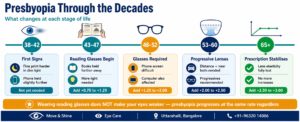
AGE 38–42: First subtle difficulty in very low light. You may hold phone slightly further away.
AGE 43–47: Reading glasses become necessary for fine print. Arm’s-length reading begins.
AGE 48–52: Standard reading glasses required for most near tasks. Prescription strengthens.
AGE 53–60: Prescription stabilises but continues to increase. Progressive lenses often needed.
AGE 65+: Most lens elasticity lost. Prescription plateau reached. Glasses will not keep increasing.
Importantly, people with existing hyperopia (farsightedness) develop presbyopia earlier than those with myopia — sometimes as early as 35–38. People with myopia may notice presbyopia later, as their distance glasses partially compensate. This is why the age of onset varies between individuals, and why a professional refraction is essential rather than self-prescribing over-the-counter reading glasses.
“Presbyopia is the one eye condition that no one escapes. Even patients who have had perfect vision their entire lives — no glasses, no contact lenses, never needed anything — will reach a point in their 40s where reading becomes effortful. The lens simply loses its youthful flexibility. What matters is getting the right prescription at the right time, and understanding which correction option fits your lifestyle, your existing prescription if any, and your visual demands.”
— Dr. Dona Susan John, Eye Care Specialist, Move & Shine Orthopedic Wellness & Eye Hospital, Bangalore
Presbyopia Symptoms: What to Watch For
The symptom pattern of presbyopia is consistent and recognisable, though patients often dismiss the early signs as temporary or external factors:
Early Signs (40s)
- Difficulty reading fine print — restaurant menus, ingredient labels, prescription bottles, newspaper text
- Needing to hold reading material further away than usual to focus clearly
- Increased difficulty reading in dim lighting compared to bright light
- Eye fatigue and mild headaches after sustained close work — reading, computer use, detailed craft work
- Temporarily blurred vision when looking between near and far objects
- Needing more light than previously when reading
Progressive Signs (Late 40s–50s)
- Reading glasses required for all near tasks, not just fine print
- Difficulty seeing the phone screen at any comfortable distance without glasses
- Arms no longer long enough — the classic sign that single-vision reading glasses are needed
- Significant difficulty with intermediate distances (computer screen, dashboard) alongside near vision
- Fluctuating prescription as accommodation continues to decline
If you are experiencing persistent headaches alongside reading difficulty, dry or stinging eyes, or blurred distance vision alongside near vision loss, these may indicate concurrent conditions requiring separate assessment. Our guides on Dry Eyes from Screen Use and Digital Eye Strain in Modern India cover these concurrent conditions in detail.
Presbyopia vs Other Eye Conditions: Important Distinctions
Presbyopia is frequently confused with other conditions — understanding the differences matters for choosing the right correction.
Presbyopia vs Hyperopia (Farsightedness)
Hyperopia is a refractive error present from birth or early life where the eyeball is too short, causing light to focus behind the retina. It affects both near AND distance vision in some patients. Presbyopia is an age-related change in lens flexibility affecting near vision specifically. They can coexist — a hyperopic person who develops presbyopia may experience significant near vision difficulty early in their 40s because the accommodation needed for near work is compounded by the hyperopic refractive error.
Presbyopia vs Myopia (Nearsightedness)
Myopia causes blurred distance vision and generally clear near vision. A myopic person developing presbyopia may have an unusual experience: their distance glasses help them see far but make near vision harder, while removing their glasses partially compensates for the near vision loss. This ‘monovision’ effect explains why some myopes delay noticing presbyopia. Eventually, presbyopia progresses to require near correction even in myopes.
Presbyopia vs Early Cataract
Cataracts involve progressive clouding of the lens, causing blurred and yellowed vision at all distances — not just near. A nuclear sclerotic cataract (central lens clouding) can actually produce a temporary ‘second sight’ effect in myopic individuals by inducing myopia that temporarily improves near vision — before vision deteriorates further at all distances. If reading difficulty is accompanied by glare, halos around lights, or overall haziness, cataract assessment is essential alongside presbyopia management. Our Cataract Surgery guide covers the full clinical picture of cataract presentation and surgical options.
Presbyopia vs Glaucoma
Glaucoma does not typically cause near vision difficulty in the early stages. It produces peripheral vision loss and, in later stages, central vision loss from optic nerve damage. The concern at Move & Shine is that patients who visit for reading glasses after 40 may have undetected intraocular pressure elevation or early glaucoma that a routine reading glasses purchase at a pharmacy counter would miss entirely. Our blog on Glaucoma Without Symptoms: Why Regular Eye Checkups Can Save Your Vision covers why the over-40 eye exam is as much about what you cannot see in the mirror as what you can.
Correction Options for Presbyopia: A Complete Guide
Once presbyopia is confirmed through a full eye examination and refraction, there are multiple correction options. The right choice depends on your existing vision prescription (if any), your lifestyle and work demands, your preference for glasses versus contact lenses, and whether surgical options are appropriate.
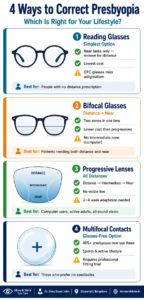
Option 1: Single-Vision Reading Glasses
Reading glasses are the simplest and most common first correction for presbyopia. They contain a single convex (plus power) lens that magnifies close objects, compensating for the lost accommodation. They are worn only for near tasks and removed for distance.
- Over-the-counter (OTC) reading glasses— available in pharmacies and supermarkets in powers ranging from +1.00 to +3.50 in 0.25 increments. Appropriate ONLY for people with no distance prescription and equal power needed in both eyes. They are a temporary and imprecise solution
- Prescription reading glasses— customised to the individual’s exact prescription in each eye, including any astigmatism correction. Essential for anyone with an existing distance prescription or significant asymmetry between the two eyes
- Computer glasses— single-vision glasses prescribed for intermediate distance (approximately 50–70 cm) rather than near (30–40 cm), specifically for screen use. Reduces neck strain from tilting the head to use bifocal or progressive lenses for computer work
The risk of OTC reading glasses: they assume both eyes need the same power and have no astigmatism correction. Using wrong-powered or asymmetric reading glasses causes eye strain, headaches, and adaption difficulty. An eye examination is always preferable. Read our guide on Why You Need a Qualified Eye Specialist Rather Than a Counter Test to understand the clinical risks of self-prescribing.
Option 2: Bifocal Glasses
Bifocal glasses have two distinct zones in a single lens: the upper portion corrects distance vision, and the lower portion (the segment) corrects near vision. There is a visible line separating the two zones.
- Suitable for patients who need both distance and near correction
- Lower cost than progressive lenses
- No intermediate distance zone — computer distance (60–80 cm) is not well corrected
- The visible line and abrupt power change can cause ‘image jump’ — a disturbing visual shift when moving eyes across the segment boundary
- Some patients never adapt; progressive lenses are often preferred for this reason
Option 3: Progressive (Varifocal) Lenses
Progressive lenses provide a gradient of power from distance (top of lens) through intermediate (middle) to near (bottom), with no visible dividing line. They are the most commonly prescribed correction for presbyopia in patients who also need distance correction.
- Advantages: seamless vision at all distances, cosmetically superior (no visible bifocal line), natural transition between zones
- Limitations: peripheral distortion in the lower corners of the lens, adaptation period of 2–4 weeks, walking down stairs requires care initially, price is higher than bifocals
- Lens quality matters significantly: premium digital progressive lenses (free-form design) have wider reading and intermediate zones and less peripheral distortion than standard progressives — worth the investment for patients who struggle with standard progressives
According to StatPearls (NCBI, 2026), vision quality is better with progressive lenses than bifocals, and time spent wearing glasses increases from 40% to 60% during working hours with progressive adoption. Neither type is tolerated easily initially, and patients may experience nausea and dizziness early in the adaptation period.
Option 4: Multifocal and Monovision Contact Lenses
Contact lenses for presbyopia are an increasingly popular option, particularly among patients who are unwilling to wear spectacles or who are active in sports. The BCLA CLEAR 2024 report reveals that more than 40% of contact lens wearers with presbyopia are now prescribed soft multifocal lenses, reflecting significant advances in lens technology.
- Soft multifocal contact lenses— simultaneous vision lenses that present both distance and near images to the eye simultaneously; the brain learns to preferentially select the appropriate image. The most common and most prescribed option
- Monovision contact lenses— one eye corrected for distance, the other for near. Requires neural adaptation; not suitable for all patients, particularly those requiring binocular depth perception for driving or sports
- Extended depth-of-focus (EDOF) lenses— newer technology that extends the range of clear vision rather than creating discrete distance/near zones; associated with better contrast sensitivity than multifocal lenses
- Rigid gas-permeable (RGP) multifocal lenses— viable for patients with high astigmatism or corneal irregularities where soft multifocals produce insufficient clarity
Option 5: Surgical Correction for Presbyopia
Surgical options for presbyopia continue to evolve rapidly. They are appropriate for patients who are suitable surgical candidates and who strongly prefer spectacle independence.
- PresbyLASIK / LASIK monovision— laser reshaping of one or both corneas to create a multifocal or monovision correction. Results vary; not suitable for patients with thin corneas or dry eye disease
- Refractive lens exchange (RLE) with multifocal or EDOF intraocular lenses— replacement of the natural lens with a premium artificial lens that corrects presbyopia and often eliminates all spectacle dependence simultaneously. Particularly appropriate for patients with concurrent hyperopia or early cataract
- Corneal inlays— small devices implanted into the cornea to improve near vision in one eye. Available in select centres
- Novel pharmacological drops— presbyopia-correcting eye drops are the newest and most exciting development. Three have received FDA approval: Vuity (pilocarpine 1.25%), Qlosi, and Vizz (aceclidine 1.44%, approved July 2025). They temporarily constrict the pupil, increasing depth of focus. Currently limited duration of effect (4–6 hours) and individual response varies significantly
All surgical options require thorough pre-operative assessment including corneal topography, ocular biometry, and evaluation of tear film and corneal health. These assessments are available at Move & Shine Eye Care.
“The most common question I receive from presbyopic patients is: which is better — progressive lenses or reading glasses? My answer is always: it depends on your life. A software engineer at a screen for eight hours needs different correction than a homemaker managing near and distance tasks. A patient who drives daily at night needs different lenses than one who walks everywhere. Presbyopia correction is not one-size-fits-all, and a full refraction — not a pharmacy counter test — is the only way to get it right.”
— Dr. Dona Susan John, Eye Care Specialist, Move & Shine Orthopedic Wellness & Eye Hospital, Bangalore
The Presbyopia Prescription: Understanding Your Reading Addition
When you are prescribed glasses for presbyopia alongside a distance correction, the near vision component is described as the Add (Addition) — the extra plus power on top of your distance prescription needed to restore near focus.
Add +0.75 to +1.25 → Early presbyopia (typically 40–44 years)
Add +1.25 to +1.75 → Moderate presbyopia (typically 44–50 years)
Add +1.75 to +2.25 → Significant presbyopia (typically 50–58 years)
Add +2.25 to +3.00 → Advanced presbyopia (typically 58+ years)
Add above +3.00 → Very rarely prescribed; magnification becomes impractical
Presbyopia prescriptions typically require updating every 2–3 years during the 40s and 50s as accommodation continues to decline. By approximately age 65, most lens elasticity is lost and the prescription stabilises — reading glasses do not need to be strengthened indefinitely.
Important myth to correct: wearing reading glasses does NOT make your eyes weaker or accelerate presbyopia progression. The presbyopia would progress at the same rate regardless of whether you wear correction or not. Avoiding glasses only causes unnecessary eye strain and headaches without preventing the underlying process.
Presbyopia in the Indian Context: Specific Challenges
The Dual-Screen Generation
India’s large IT and knowledge worker population faces a particularly challenging visual demand: sustained computer use (intermediate distance, typically 60–80 cm) combined with phone use (near distance, 30–40 cm) and client presentations or videoconferencing (near-intermediate) — all in an eight-to-ten-hour working day. Standard bifocals are poorly suited to this demand profile. Computer glasses or progressive lenses with an enhanced intermediate zone are usually the appropriate solution. Read our guide on The 20-20-20 Rule: Preventing Digital Eye Strain for the complementary habit-based approach to screen-related eye fatigue that works alongside correct presbyopia correction.
Premature Presbyopia in Indians
Several studies confirm that South Asian populations develop clinically significant presbyopia at a younger average age than Western populations — with some patients experiencing reading difficulty as early as their late 30s. Contributing factors include higher ambient temperatures (which may affect lens metabolism), nutritional factors, and potentially genetic factors. This is why annual eye examinations should be standard practice from age 38 in Indian adults, not 45 as commonly assumed in Western guidelines.
Uncorrected Presbyopia: A Public Health Issue
A cross-sectional study from South India (NCBI, 2022) found that despite 76.61% of over-40 patients presenting with presbyopia symptoms, a significant proportion remained uncorrected — primarily due to social stigma (particularly among women who resist visible reading glasses), economic factors, and lack of access to qualified eye examination. Uncorrected presbyopia reduces productivity, reading ability, and quality of life significantly. The WHO has identified uncorrected presbyopia as a major preventable cause of near vision impairment globally.
Nutrition for Lens Health: Can You Slow Presbyopia?
Presbyopia cannot be prevented — it is universal. But the health of the crystalline lens and the surrounding structures can be supported nutritionally, potentially influencing the rate and severity of age-related lens changes including presbyopia and, more importantly, cataract formation.
Key Nutrients for Lens Health
- Lutein and Zeaxanthin— carotenoid antioxidants that concentrate specifically in the lens and retina. They reduce oxidative stress on the lens and have strong evidence for reducing cataract progression. Sources: palak (spinach), methi (fenugreek), drumstick leaves (moringa), yellow corn, egg yolks
- Vitamin C— the highest concentration of Vitamin C in the human body is found in the aqueous humour of the eye, where it protects the lens from UV-induced oxidative damage. Amla (Indian gooseberry) is among the richest sources globally. Also: guava, citrus, bell peppers
- Vitamin E— fat-soluble antioxidant protecting lens cell membranes from oxidative damage. Sources: sunflower seeds, almonds, groundnut oil
- Omega-3 Fatty Acids— support tear film quality (relevant to contact lens comfort), reduce ocular surface inflammation, and support retinal photoreceptor function. Sources: flaxseeds, walnuts, fatty fish
- Zinc— essential cofactor for antioxidant enzymes in the eye, particularly in the retina. Sources: pumpkin seeds, legumes, whole grains
- Riboflavin (Vitamin B2)— specifically involved in lens energy metabolism; deficiency has been associated with increased cataract risk. Sources: dairy products, eggs, green leafy vegetables
- Avoid excess UV exposure— UV radiation accelerates lens clouding and oxidative damage. UV-blocking sunglasses are as important a nutritional intervention as diet — because preventing oxidative damage is equivalent to adding antioxidants
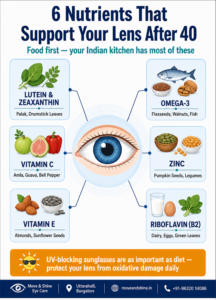
These nutrients are also covered in the context of general eye health in our guides on Periodic Eye Checks and Vision Health and Why Indian Athletes Must Prioritise Eye Health.
When to See an Eye Specialist in Bangalore for Presbyopia
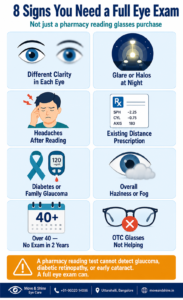
Many people in Bangalore manage early presbyopia with pharmacy-purchased reading glasses for months or years before seeing an eye specialist. Here is when professional assessment is essential:
- You are 40 or older and have not had an eye examination in the past 1–2 years — regardless of symptoms
- Reading glasses from a pharmacy are not resolving your difficulty or are causing headaches
- You notice different clarity in your two eyes — one eye sees close objects clearly while the other does not
- You have an existing distance prescription and need near vision correction added
- Vision fluctuates day to day or in different lighting conditions
- You are experiencing glare, halos, or haziness alongside reading difficulty — possible early cataract
- You have diabetes or a family history of glaucoma — annual examination is non-negotiable after 40
- You are considering contact lenses or surgical correction for presbyopia
Annual eye examinations after 40 are not just about the reading prescription. They are the opportunity to detect glaucoma, diabetic retinopathy, early macular degeneration, and other conditions that are asymptomatic in their early stages. Read our guide on Eye Check-up in Geriatrics: Why Regular Exams Matter for the full perspective on preventive eye care after midlife.
Patients with diabetes require particular attention — diabetic retinopathy can occur without noticeable vision change until it is advanced, and the combination of diabetic retinopathy and uncorrected presbyopia is a significant contributor to avoidable vision impairment in Indian adults. Our Diabetic Retinopathy guide covers the screening and management of this condition.